Planning a Lumen Voice Services Transition
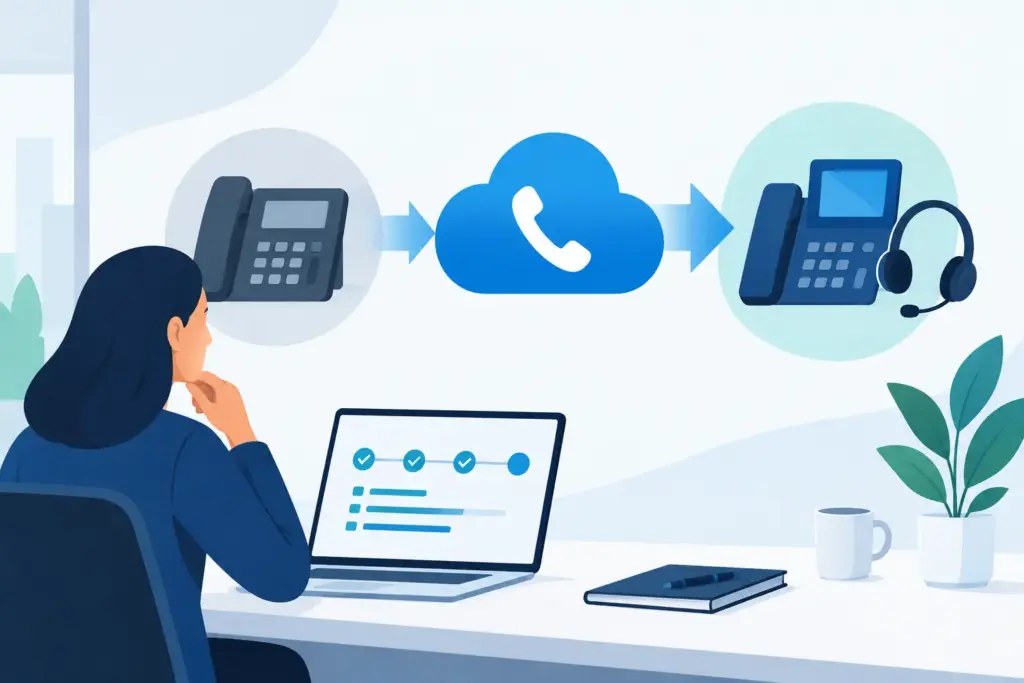
A Lumen Voice Services Transition is not a carrier swap to manage through a ticket queue. For enterprises with distributed offices, contact centers, legacy PBXs, Microsoft Teams calling, and customer-facing phone lines, it is a live infrastructure change with direct consequences for revenue, response times, and business continuity. The right transition plan protects every number, call path, emergency service record, and integration while giving the organization a stronger operating model on the other side.
The central question is not simply where voice traffic will terminate next. It is how to replace or modernize underlying voice services without creating a disruption that employees and customers feel immediately. That requires carrier-grade design, accurate discovery, staged porting, and engineering ownership from assessment through post-cutover validation.
Why a Lumen Voice Services Transition Requires Architecture First
Voice environments accumulate complexity over time. A corporate headquarters may use SIP trunks into an on-premises PBX, while branch offices rely on local PRI circuits, mobile employees place calls through Microsoft Teams, and contact center queues route through a separate platform. Each system can have different carrier contracts, dialing rules, failover behavior, and number inventories.
A transition that treats these services as a single block is likely to miss critical dependencies. A main published number may forward to an after-hours answering group. A toll-free number may be embedded in campaign materials. A location's emergency calling record may depend on a specific service address. An analog line may still support an elevator, alarm panel, fax device, or backup circuit.
The first phase should therefore establish a current-state voice map. It should document every number range, carrier service, trunk group, call flow, platform integration, site, and business owner. More importantly, it should identify which services cannot tolerate interruption and what a successful failover looks like for each one.
This discovery work creates the foundation for rational decisions. Some organizations should consolidate voice into a cloud platform. Others need a hybrid design that retains local survivability at selected facilities. A contact center may stay on Genesys or another established platform while carrier connectivity and administrative controls are modernized underneath it. The correct answer depends on operational needs, not a one-size-fits-all migration pattern.
Build the Target State Around Resilience and Control
The target environment should reduce carrier sprawl without concentrating risk in one path. A well-designed cloud voice architecture combines redundant carrier connectivity, intelligent routing, geographic diversity, and real-time monitoring. If a primary route or regional service element is unavailable, calls need a predefined alternate path rather than a manual escalation process.
For many enterprises, Microsoft Teams is central to this design. Direct carrier calling inside Teams can replace disconnected desk-phone and softphone experiences while preserving enterprise dialing, number assignment, emergency calling controls, and policy-based routing. Employees can make and receive business calls in the same collaboration environment where they message, meet, and coordinate work.
That does not mean every workflow should move into Teams. Reception consoles, executive assistant workflows, common-area devices, contact center queues, and high-volume service lines may need specialized capabilities. The architecture should integrate these requirements instead of forcing teams into a simplified model that creates workarounds later.
A strong target-state design answers practical questions before cutover:
- Which inbound numbers require automatic failover to another site, queue, or mobile destination?
- What happens if an internet circuit at a branch location fails?
- Which users need Teams calling, a physical device, a contact center endpoint, or more than one option?
- How will emergency calling locations be maintained as employees move between offices and remote sites?
- Where will call quality, trunk capacity, routing failures, and service status be monitored?
These are not edge cases. They define whether the new environment can sustain continuous uptime under real operating conditions.
Treat Number Porting as a Business-Critical Workstream
Number porting is often the highest-risk component of a Lumen Voice Services Transition because it connects carrier processes to customer-facing operations. A port order can fail for reasons that appear administrative but have material business impact: mismatched account information, an incorrect service address, a partial number inventory, unauthorized signatures, or unrecognized dependencies on a legacy circuit.
The solution is disciplined port governance. Validate carrier records against the actual number inventory. Separate numbers by service type, location, criticality, and destination. Confirm which numbers are tied to toll-free routing, fax, alarm systems, conference services, or third-party applications. Then schedule ports in waves that match business risk, not merely geographic convenience.
A low-risk pilot is valuable because it validates the entire process: order submission, provisioning, routing configuration, user communications, cutover procedures, and post-port testing. The pilot should include a representative set of real conditions, such as an office line, a remote user, an inbound queue, and an emergency calling scenario.
For high-volume lines, the cutover plan should identify named technical and business owners, a minute-by-minute test sequence, escalation contacts, and a fallback route. Call testing must cover inbound and outbound calling, local and long-distance dialing, toll-free access where applicable, voicemail, transfer behavior, caller ID, emergency calling, and contact center handoffs. A port is not complete when the carrier marks it complete. It is complete when the business confirms the service works as designed.
Integrations Must Be Tested as Call Flows, Not Checkboxes
Enterprise voice rarely operates in isolation. Calls can enter through Teams, Cisco, Zoom, Genesys, 8x8, a legacy PBX, a CRM screen pop, or an AI receptionist. The question is not whether an integration exists. The question is whether the complete customer and employee call flow behaves correctly under normal and failure conditions.
Consider an inbound service request. A caller reaches the main number, hears an AI voice agent, provides an account number, schedules a service appointment, and receives an SMS confirmation. If the request requires a person, the call routes to the correct queue with context. That workflow involves voice routing, speech recognition, business rules, contact center availability, and messaging. A transition plan must validate each handoff.
AI voice automation can be particularly useful during and after modernization because it absorbs routine calls that would otherwise create queues. It can answer common questions, collect caller intent, schedule services, route requests, and provide always-on coverage. But automation should be deployed with defined escalation paths and clear reporting. For complex, sensitive, or exception-based requests, callers need a reliable route to a qualified person.
Run the Cutover Like an Operational Event
A successful cutover has three stages: preparation, controlled execution, and stabilization. Preparation includes configuration reviews, number inventory reconciliation, user readiness, device provisioning, network validation, and change communications. Controlled execution includes real-time monitoring, scheduled port windows, functional testing, and an active escalation bridge. Stabilization includes call-quality review, routing adjustments, user support, and documentation updates.
Network readiness deserves particular attention. Cloud voice quality depends on more than broadband speed. IT teams should assess latency, jitter, packet loss, DNS behavior, firewall policies, session border controller configuration, Wi-Fi capacity, and quality-of-service treatment. A voice migration can expose weaknesses that were hidden when most calls remained on local PBX hardware.
There is also a trade-off between speed and control. Moving every location on one date can shorten the overall project, but it raises the blast radius if a configuration issue appears. A phased rollout takes longer, yet it creates room to correct designs, train users, and prove routing patterns before larger locations move. Enterprises with strict uptime requirements usually benefit from phased execution, especially when multiple carriers, legacy systems, or contact center platforms are involved.
Measure Outcomes After the Transition
The work does not end when legacy services are disconnected. Leadership needs evidence that the new environment is delivering lower overhead and better service. Track call completion, call-quality indicators, inbound abandonment, average speed to answer, transfer rates, route failures, outage incidents, and time required to add or change users.
Administration is another meaningful outcome. A consolidated environment should give IT clearer visibility into numbers, users, call flows, carrier services, and support activity. If routine moves, adds, and changes still require multiple vendors and manual spreadsheets, the transition has not fully solved the operational problem.
UCC Networks approaches these projects as engineering-led communications modernization, combining carrier-grade connectivity, platform integration, migration planning, and ongoing operational support. The objective is not simply to replace a service provider. It is to create a voice environment that can absorb growth, support distributed work, and keep customer communications moving when conditions are less than ideal.
The most useful next step is a transition assessment that turns the existing voice estate into a prioritized action plan. Start with the numbers, call flows, integrations, and locations your organization cannot afford to lose. Once those are understood, the path to a controlled, zero-downtime migration becomes far more practical.