Cloud PBX Versus On-Premises for Enterprises
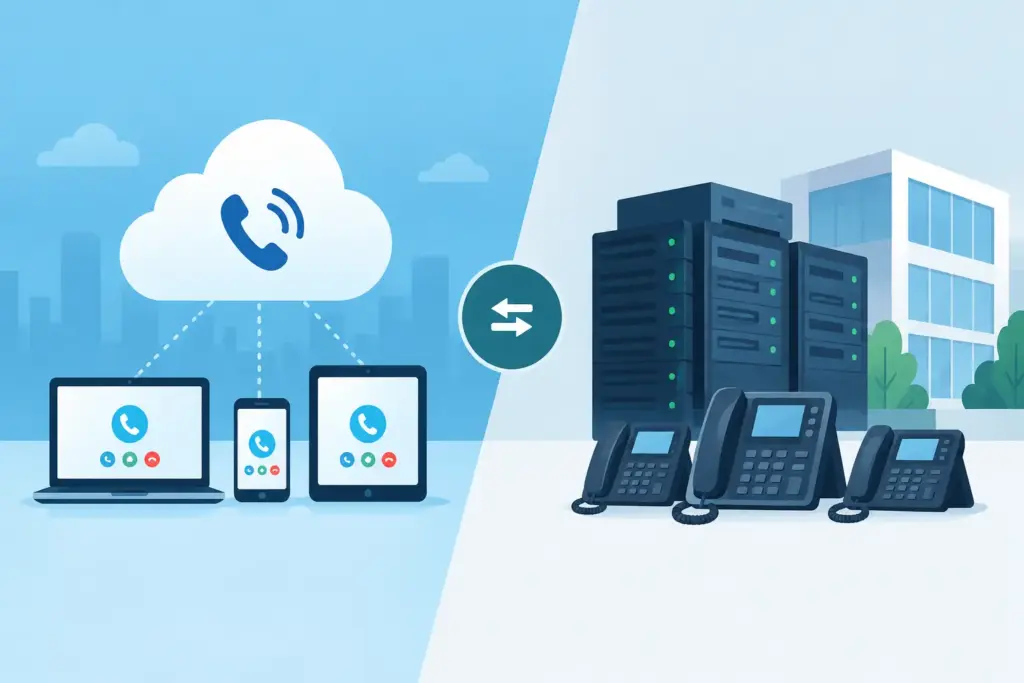
A branch loses power. A carrier circuit fails. A regional office closes unexpectedly. These are the moments that expose whether voice communications are designed as business-critical infrastructure or treated as a collection of phone lines. The cloud PBX versus on premises decision is therefore not simply a technology preference. It determines how quickly teams can respond, how reliably customers reach the business, and how much operational effort IT must spend maintaining voice.
For mid-market and enterprise organizations, the strongest answer is rarely based on a single feature or a per-seat price. It depends on call volumes, compliance obligations, existing platforms, network maturity, geographic distribution, and the cost of even a short communications outage.
Cloud PBX versus on-premises: the operating model
An on-premises PBX places call-control hardware and software in a company data center or communications room. The organization owns or licenses the platform, manages upgrades, maintains local survivability, and typically connects it to carriers through SIP trunks or legacy circuits. This model can offer direct control over architecture and configuration, especially in facilities with specialized analog devices, isolated networks, or highly customized call flows.
A cloud PBX moves core call control, routing, feature delivery, and administration to provider-operated infrastructure. Users connect through desk phones, softphones, mobile applications, collaboration clients, and browser-based tools. IT administers policy centrally while the provider operates the underlying voice environment, carrier interconnects, platform updates, and resilience design.
The practical difference is responsibility. With on-premises voice, internal teams are accountable for much of the technology stack. With a cloud deployment, the enterprise still owns policy, identity, endpoint standards, network readiness, and governance, but it shifts infrastructure operations to a communications partner with carrier-grade infrastructure.
Uptime is an architecture question, not a location question
A common assumption is that an on-premises PBX is more reliable because it is physically nearby. That is only true when the organization has engineered redundancy across power, hardware, carriers, routes, sites, and staffing. One PBX in one building can become a single point of failure, even if the server itself is highly available.
A properly designed cloud PBX can maintain continuous uptime through geographically distributed infrastructure, multi-carrier routing, session border controller design, redundant internet paths, and automatic failover to mobile or alternate locations. If a headquarters loses connectivity, users may continue handling calls from home, a branch office, or a mobile device without rebuilding a disaster-recovery plan in the middle of an outage.
That does not mean cloud voice removes network dependency. Voice quality still depends on last-mile connectivity, local LAN performance, Wi-Fi design, quality-of-service policies, and endpoint health. Enterprises with poor circuit diversity or unmanaged branch networks can carry those weaknesses into any cloud platform. The right deployment begins with network assessment and failover planning, not a license order.
Cost control extends beyond PBX hardware
On-premises systems can appear less expensive when the organization has already paid for hardware and has internal telecom expertise. But the cost model includes more than a maintenance contract. Consider software upgrades, replacement servers, security patching, carrier management, disaster-recovery infrastructure, specialist labor, power and rack space, and the time required to support moves, adds, changes, and site expansions.
Cloud PBX pricing usually shifts spending toward predictable operating expense. That can lower capital requirements and simplify expansion, particularly for businesses adding remote employees, acquisitions, seasonal teams, or new locations. Centralized administration also reduces the friction of assigning numbers, changing call queues, and applying policies across hundreds or thousands of users.
The trade-off is that recurring costs deserve disciplined review. Enterprises should evaluate total monthly charges, international calling requirements, contact center usage, compliance recording, API needs, analog-device support, and the price of advanced capabilities. A low headline seat price can become expensive if it does not include the carrier connectivity, implementation engineering, support model, or integrations the business actually needs.
Collaboration platforms change the calculation
For organizations standardized on Microsoft Teams, Cisco, Zoom, Genesys, or 8x8, the phone system should not operate as a disconnected island. Calling, presence, messaging, contact center workflows, and identity management need a clear integration model.
A cloud approach can bring carrier calling directly into Microsoft Teams, allowing employees to use the collaboration interface they already know while IT maintains centralized number management, emergency calling policies, call-routing controls, and reporting. It can also connect customer-facing voice workflows to contact center platforms without forcing every employee into a separate softphone experience.
On-premises environments can integrate with these platforms, but the engineering path may be more complex. It often requires additional gateways, session border controllers, custom routing, and separate support boundaries. This can be justified where a company has a strategic legacy investment or specialized facility requirements. It is less compelling when IT is trying to reduce fragmented tools and simplify the employee experience.
Security and compliance require shared accountability
Neither architecture is automatically more secure. On-premises PBX environments give organizations direct control over infrastructure, but they also create direct responsibility for patching, access control, certificates, fraud prevention, backups, and vulnerability response. Unsupported voice systems are an attractive target for toll fraud and lateral movement.
Cloud providers can centralize security operations, platform patching, encrypted signaling and media options, identity integration, audit controls, and continuous monitoring. Yet the customer must still enforce multifactor authentication, role-based administration, device policies, network segmentation, and appropriate retention rules for recordings and messages.
For regulated industries, the evaluation should move beyond general security claims. Ask where call data is processed, how logs are retained, how emergency services are handled, what controls exist around recordings, and who is accountable when a carrier route or identity provider fails. The most effective solution documents these responsibilities before deployment.
When on-premises PBX still makes sense
On-premises voice remains viable for some environments. Manufacturing plants, hospitals, campuses, government facilities, and organizations with extensive analog equipment may need local call control or survivability because operations cannot depend entirely on external connectivity. Highly customized integrations and sunk investments may also justify a phased approach rather than a complete replacement.
Even then, the choice does not have to be binary. A hybrid architecture can preserve local services while moving knowledge workers, remote sites, carrier connectivity, or collaboration calling to the cloud. This reduces risk and allows the business to modernize on an operational schedule rather than forcing a disruptive cutover.
The risk is allowing “hybrid” to become permanent complexity. Every retained component should have a documented purpose, support owner, failover behavior, and retirement plan. Otherwise, the organization keeps the cost of two systems without receiving the resilience or simplicity promised by either.
AI voice automation favors a cloud-native foundation
Customer experience is reshaping the PBX decision. Voice AI agents can answer routine calls, identify intent through natural speech, schedule appointments, provide status updates, route urgent requests, and transfer complex cases with context. The operational objective is direct: reduce queues and create zero hold times for the interactions that do not require a live agent.
These capabilities depend on real-time integration with voice routing, customer systems, calendars, contact center workflows, and analytics. Cloud architecture generally accelerates this work because APIs, elastic capacity, and centralized policy are already part of the platform model. An on-premises PBX can support AI integrations, but doing so often introduces gateways and custom development that slow deployment and complicate support.
AI should be evaluated as part of a communications workflow, not as a standalone bot. The key questions are whether it can recognize intent accurately, escalate safely, preserve context, protect customer data, and report on containment, transfer reasons, and response times.
Plan the migration around business continuity
A successful move is not a porting event. It begins with an inventory of numbers, call flows, carriers, endpoints, analog devices, emergency locations, integrations, and peak call patterns. From there, teams can define target architecture, pilot a representative group, validate call quality, test failover, train users, and cut over in controlled waves.
Zero-downtime migration is achievable when routing and carrier transitions are engineered in advance. That includes temporary forwarding, parallel testing, port sequencing, rollback procedures, and a clear escalation path across the provider, carrier, network team, and internal service desk. The goal is not merely to avoid missed calls on cutover day. It is to leave the organization with a supportable communications environment afterward.
The best decision is the one that gives your organization more control over outcomes, not necessarily more equipment to manage. For enterprises modernizing collaboration and customer service, a cloud PBX designed with redundant carrier connectivity, integration discipline, and direct engineering support can turn voice from a maintenance burden into always-on operational infrastructure. UCC Networks approaches that transition as an architecture and continuity program, because the phone system must perform when the rest of the business is under pressure.