Carrier Outage Recovery That Preserves Uptime
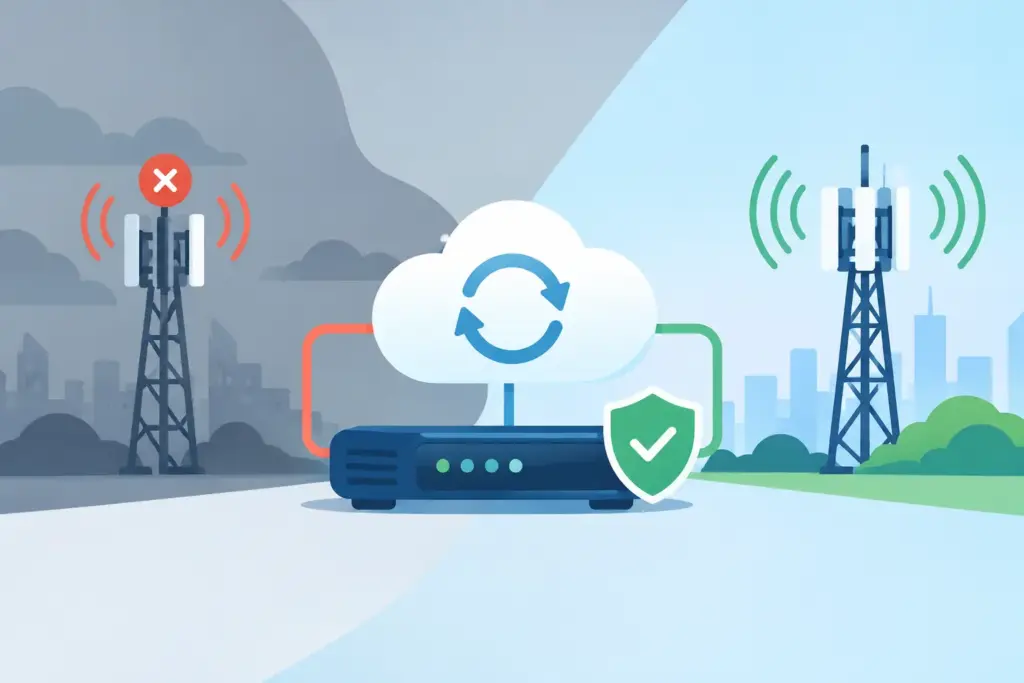
A carrier outage rarely announces itself as a carrier outage. It starts as a cluster of failed calls, one-way audio, unavailable DIDs, delayed SMS messages, or contact center queues that stop draining. Effective carrier outage recovery determines whether those symptoms become a contained routing event or a customer-facing operational failure.
For enterprise communications teams, the question is not whether a carrier will experience a disruption. Every carrier, cloud region, upstream network, and local access circuit can fail. The real question is whether voice traffic, customer workflows, and internal collaboration can continue while engineering teams isolate the fault.
Carrier Outage Recovery Is an Architecture Decision
Many organizations treat recovery as an escalation process: open a ticket, wait for a carrier status update, and notify business leaders. That approach leaves the carrier as the single point of operational control. It may be acceptable for a low-volume office line. It is not acceptable for a healthcare scheduling center, a distributed financial services operation, a field-service organization, or an enterprise contact center where every missed call has a measurable cost.
A recovery-capable communications environment is designed so that inbound and outbound services have alternate paths before an incident occurs. That means separating the logical telephone number from a single terminating carrier, maintaining carrier-grade interconnects, and defining routing rules that can shift traffic without requiring a full platform migration during an outage.
The distinction matters. Simple call forwarding can provide basic coverage, but it often creates new problems: lost caller ID, reduced capacity, unavailable call recording, broken contact center reporting, or routing loops. Carrier outage recovery should preserve the business workflow, not merely make a phone ring somewhere else.
What must remain available
The correct design depends on the organization, but most enterprise recovery plans protect four outcomes: inbound customer access, outbound calling, emergency and priority calling, and administrative control over routing.
Inbound continuity is usually the first priority. Customers must reach the right department, agent group, AI voice agent, or emergency message even when a primary carrier path is impaired. Outbound continuity matters just as much for sales teams, service dispatchers, collections operations, and clinical teams that need to return calls without presenting inconsistent numbers.
Administrative control is often overlooked. During an incident, IT teams need real-time visibility into failed call attempts, carrier response codes, route performance, and queue conditions. A recovery plan that requires manual carrier intervention before traffic can be moved is not a rapid recovery plan.
Build Failover Around Real Failure Modes
Not all outages look alike, and a single failover policy cannot address every one. A carrier might have a regional transport issue, a SIP trunk registration failure, a routing-table error, a degraded peering connection, a denial-of-service event, or a local circuit failure at one site. Cloud collaboration platforms can also remain available while PSTN calling is disrupted, creating a confusing partial-outage scenario for users.
This is why multi-carrier redundancy should be paired with intelligent routing policies. Traffic can be directed based on carrier health, geography, dialed number, business unit, call type, capacity thresholds, and time of day. A contact center may need calls rerouted to an alternate carrier while preserving existing queue logic. A distributed enterprise may need only a specific region shifted, leaving healthy traffic on the preferred route.
A well-engineered environment can also distinguish between automatic and controlled failover. Automatic failover is appropriate when a route is clearly unavailable and every second matters. Controlled failover can be preferable when a route is degraded but functional, because moving all traffic at once may introduce avoidable cost or capacity pressure on the secondary carrier.
The right answer depends on your tolerance for call loss, the volume of concurrent sessions, regulatory obligations, and the operational impact of changing routes. Recovery design is not about adding carriers for their own sake. It is about establishing alternate paths that have enough capacity, are continuously monitored, and can preserve the services that matter most.
Preserve the Customer Experience, Not Just Dial Tone
During an outage, organizations often focus on whether calls connect. Customers focus on whether they receive help. A call that reaches a generic backup line but cannot be routed, identified, recorded, or resolved still creates friction and higher operating cost.
Recovery policies should account for the full customer journey. If a caller reaches a service department after primary routing fails, the system should still identify the number dialed, apply the correct business-hours policy, provide language options, and deliver the call to the correct queue or automation workflow. For high-volume environments, an AI voice agent can maintain first-response availability by answering routine questions, collecting intent, scheduling service, or routing urgent requests while live-agent capacity is constrained.
This is particularly valuable when an outage coincides with a volume spike. Redirecting every call to a smaller backup team may prevent immediate call failure but produce long hold times. Intelligent automation can absorb common requests and protect agents for high-value or exception-based conversations. The goal is not simply backup coverage. It is zero hold times where automation can resolve the request and a controlled escalation path where human expertise is required.
A Carrier Outage Recovery Runbook Must Be Executable
Technical redundancy only works if the people responsible for operations know how to use it. A practical runbook should define ownership and decision rights before an incident. It should also be tested against actual call scenarios rather than treated as a document for audit purposes.
A useful runbook covers at least these operational actions:
- Confirm the scope of impact through call tests, monitoring data, SIP response patterns, and carrier status information.
- Classify the incident as carrier-wide, regional, site-specific, platform-specific, or number-specific before shifting broad traffic volumes.
- Activate the appropriate alternate route, including capacity controls and any emergency routing priorities.
- Validate inbound, outbound, toll-free, local, international, E911, recording, and contact center behavior after failover.
- Communicate a concise business status update, then document timestamps, route changes, and recovery observations for post-incident improvement.
Testing is where many plans fail. A backup carrier route that has never carried production-scale traffic may have hidden capacity limits, missing caller ID configuration, or incomplete number porting records. Test both planned and unplanned-style scenarios. Simulate a primary trunk failure, a regional route impairment, and a contact center overflow event. Confirm that administrators can make routing changes without depending on a single unavailable person or a carrier support queue.
Monitor the Signals That Appear Before an Outage Ticket
Carrier dashboards are useful, but they are not sufficient. They may report a confirmed outage after users have already experienced failures, and they rarely provide the business context necessary to prioritize response.
Enterprise monitoring should correlate network performance with voice outcomes. Watch for rising SIP failures, failed registrations, increased post-dial delay, packet loss, jitter, one-way audio reports, sudden drops in answered-call rates, queue abandonment, and unusual changes in outbound completion rates. These signals can reveal a degrading route before it becomes a complete interruption.
Visibility should also extend to dependencies outside the carrier. A site firewall rule, DNS issue, SBC configuration change, expired certificate, cloud connectivity problem, or Microsoft Teams calling policy can create symptoms that resemble a carrier outage. Fast diagnosis prevents the team from rerouting healthy carrier traffic while the actual issue remains unresolved.
For distributed organizations, centralized administration is essential. IT should be able to see route health across locations and platforms from one operational view, whether users are calling through Microsoft Teams, a contact center application, a legacy PBX, or a cloud UC platform. Fragmented visibility makes recovery slower precisely when speed matters.
Integrations Change the Recovery Design
Modern enterprises do not operate a single voice system. They operate communications ecosystems that include Microsoft Teams, Cisco, Zoom, Genesys, 8x8, CRM platforms, scheduling tools, and specialized line-of-business applications. Carrier recovery needs to work across those environments without forcing users to adopt a separate emergency workflow.
For example, Teams users may need to retain enterprise caller ID and dial-out capability when a primary PSTN route fails. Contact center agents need their queue assignments and presence logic preserved. CRM-integrated teams need call records associated with the correct customer interaction. If the recovery path bypasses these systems, operations may continue at a basic level while reporting, compliance, and customer context break down.
This is why direct-routing strategy, session border controller design, carrier diversity, and application integration should be assessed together. Recovery is not a telecom feature bolted onto the edge of the network. It is part of the communications architecture.
Move From Reactive Escalation to Controlled Continuity
The strongest carrier outage recovery programs turn carrier incidents into managed events. They combine multi-carrier connectivity, policy-based routing, continuous monitoring, tested operational runbooks, and customer-service workflows that remain functional under pressure.
UCC Networks designs carrier-grade voice environments around that standard, including alternate carrier routing, integrated collaboration calling, contact center continuity, and AI voice automation that keeps customers moving when live capacity is constrained. The value is not merely another trunk or another dashboard. It is the ability to maintain control when the primary path fails.
Review the last carrier incident your organization experienced. If recovery depended on waiting for a status page or manually forwarding calls, the next planning conversation should focus on where routing authority, capacity, and customer context actually reside. That is where continuous uptime begins.