Can AI Schedule Customer Appointments at Scale?
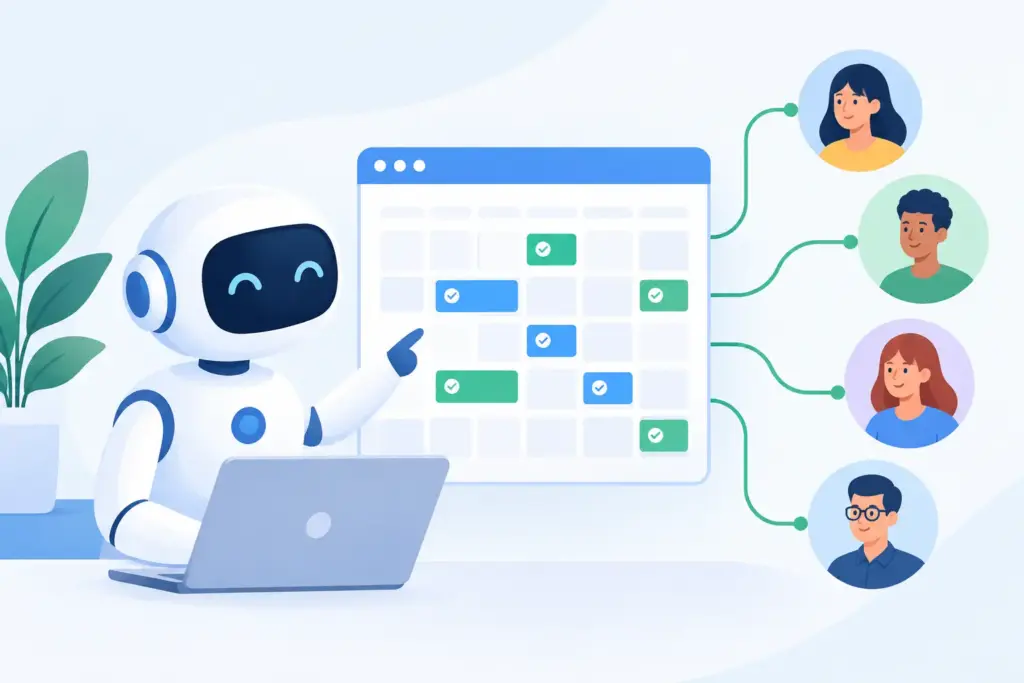
A customer calls at 7:12 p.m. to book a service visit, reschedule a consultation, or confirm an appointment before traveling across town. If the call reaches a queue or voicemail, the organization risks more than a missed booking. It risks lost revenue, a poor first impression, and a customer who calls a competitor. So, can AI schedule customer appointments? Yes, when it is connected to the systems that hold availability, customer records, routing rules, and business policies.
For enterprise organizations, appointment automation is not a chatbot feature bolted onto a calendar. It is a voice, workflow, and infrastructure decision. The AI agent must understand a caller's intent, identify the right service or provider, verify available time slots, create or modify the appointment, send confirmation, and escalate exceptions without creating a new operational bottleneck.
Can AI Schedule Customer Appointments Reliably?
AI can schedule, reschedule, cancel, and confirm appointments by voice, SMS, web chat, or collaboration channels. A capable agent can ask qualifying questions in natural conversation, such as location, service type, preferred time, account number, or urgency. It can then apply scheduling rules and write the outcome to the organization’s calendar, CRM, field service platform, practice management system, or contact center workflow.
The distinction is important: an AI agent does not simply suggest available times. In an enterprise deployment, it should execute a controlled transaction. It checks the appropriate calendar or scheduling API, confirms the selected slot, records the interaction, and triggers the next action, whether that is an SMS confirmation, a Teams notification, a dispatch ticket, or a human handoff.
Consider a multi-location service organization. A caller says, “I need someone at our Phoenix site tomorrow morning.” The AI should identify the account, recognize the location, determine whether the request is emergency or standard service, find technicians with the required certification, account for travel or service territory rules, and offer valid appointment windows. If no qualifying option exists, it should route the call with the collected context to the correct team.
That is how AI scheduling supports zero hold times without sacrificing control. The agent handles routine demand continuously, while employees focus on exceptions, high-value conversations, and work that requires judgment.
What Enterprise AI Appointment Scheduling Requires
The quality of the scheduling experience depends on the environment behind it. An AI voice agent is only as dependable as its integration design, data access, telephony path, and escalation logic.
Accurate availability and scheduling rules
The agent needs a trustworthy source of availability. That may be Microsoft 365 calendars, a CRM, an appointment platform, a field service application, or a custom scheduling database. It must also understand the rules that make availability meaningful: service duration, buffers, provider qualifications, geography, office hours, blackout dates, capacity limits, and cancellation policies.
Without these controls, AI can create the appearance of automation while generating conflicts for staff. For example, a 30-minute consultation may require 15 minutes of preparation, or a field appointment may need a two-hour travel window. Those constraints must be reflected in the scheduling workflow, not handled after the booking is made.
Natural conversation with deterministic outcomes
Customers do not speak in perfectly structured commands. They change their minds, ask follow-up questions, provide incomplete information, and describe urgency in different ways. The voice layer must recognize conversational intent while the workflow layer keeps the transaction precise.
A well-designed agent can respond naturally: “I can help with that. Is this for an existing appointment or a new service request?” Behind that response, the system is collecting the fields required to complete the booking. It should confirm key details before committing the appointment, especially date, time, location, service, and contact information.
Human escalation that preserves context
Automation should not force every caller through the same path. Some requests involve billing disputes, clinical triage, complex projects, accessibility needs, or account authorization issues. The AI must recognize when a request falls outside policy and transfer it intelligently.
The handoff should include the caller’s identity, reason for calling, selected service, attempted time slots, and conversation history. Requiring the customer to repeat everything to a live employee defeats much of the value of automation. Context-aware routing shortens handle times and gives employees a stronger starting point.
Carrier-grade voice and operational resilience
Appointment scheduling often begins with an inbound call, which makes telephony reliability part of the customer experience. Low-latency audio, redundant carrier connectivity, call routing controls, monitoring, and failover determine whether an AI agent is reachable when call volumes rise or a local system fails.
This matters most for organizations where appointments drive revenue or operations: healthcare networks, property management groups, dealerships, financial services firms, professional services providers, and field service enterprises. A scheduling agent that works only during normal conditions is not an always-on service channel.
Where AI Scheduling Produces the Strongest Results
AI appointment scheduling is most effective where request patterns are frequent, rules are defined, and customers expect immediate answers. It can absorb after-hours calls, seasonal surges, lunch-hour peaks, and overflow from an understaffed contact center.
For healthcare and wellness organizations, the agent can manage nonclinical bookings, confirmations, cancellations, and reminder workflows while routing sensitive or urgent needs according to policy. For field service teams, it can capture issue details, schedule qualified dispatches, and notify technicians or operations teams. For professional services, it can book consultations based on advisor availability, office location, client status, and meeting type.
Distributed enterprises also benefit when appointment requests enter through different channels. A customer may start on web chat, call later for clarification, and receive confirmation by SMS. The operational goal is not merely to automate each channel. It is to maintain one accurate appointment record and one consistent customer experience across all of them.
The Trade-Offs Leaders Should Plan For
AI is not the right answer for every scheduling scenario without configuration. Highly variable services, inconsistent calendars, undocumented exception rules, and fragmented customer data can reduce accuracy. Those conditions do not rule out automation, but they change the deployment approach.
Start with the appointment types that have clear workflows and measurable volume. A standard installation visit, intake consultation, maintenance window, or account review is usually easier to automate than a complex custom engagement. As the agent proves its performance, the organization can add more intents, locations, languages, and integration depth.
There is also a governance question. Leaders should determine what the AI may book independently, when it must request confirmation, when it must transfer to a person, and how it records consent or policy disclosures. In regulated environments, these controls should be designed with security, compliance, and legal stakeholders rather than treated as a late-stage review.
Building an Appointment Automation Architecture
A production-ready design connects the conversational layer to enterprise communications and systems of record. The AI listens and responds through the voice environment, while APIs and workflow services handle identity, availability, booking, notification, and reporting. Centralized administration gives IT teams visibility into prompts, routing rules, integrations, recordings, and performance.
For organizations using Microsoft Teams, Cisco, Zoom, Genesys, 8x8, or a legacy PBX estate, interoperability matters. The objective is to improve the customer journey without forcing a disruptive replacement of every existing platform. A phased deployment can place AI at the front of designated call flows while preserving established teams, queues, numbers, and escalation paths.
UCC Networks approaches this as a communications architecture problem, combining AI voice automation with carrier-grade connectivity, integration engineering, and managed support. That combination matters because a scheduling workflow touches customer experience, contact center operations, network reliability, and the applications that run the business.
Metrics that prove operational value
The right measurement framework goes beyond the number of calls answered. Track containment rate, completed bookings, abandoned-call rate, average time to appointment, after-hours conversion, reschedule success, transfer rate, and booking error rate. Compare results by location, appointment type, channel, and time of day.
The best signal is often the operational outcome. Are more appointments being booked outside business hours? Are employees spending less time on repetitive calendar work? Are customers reaching a resolution without waiting? Are no-shows decreasing because confirmations and reminders are triggered consistently?
These metrics expose where refinement is needed. A high transfer rate may indicate missing policy logic. A low completion rate may point to confusing prompts, poor calendar data, or a difficult authentication step. Continuous tuning turns the AI agent from a static script into an operational service layer.
Start With the Calls Customers Cannot Afford to Miss
The practical first step is to map the inbound appointment journey from first call to final confirmation. Identify the highest-volume request types, the systems that control availability, the exceptions that require people, and the communications channels customers already use. Then design the voice and workflow experience around those realities.
AI scheduling works best when it is treated as dependable communications infrastructure, not a novelty. When availability data is accurate, routing is intentional, and the voice environment is engineered for continuous uptime, every answered call becomes an opportunity to serve the customer immediately rather than ask them to wait.