Zero Downtime PBX Migration Without Missed Calls
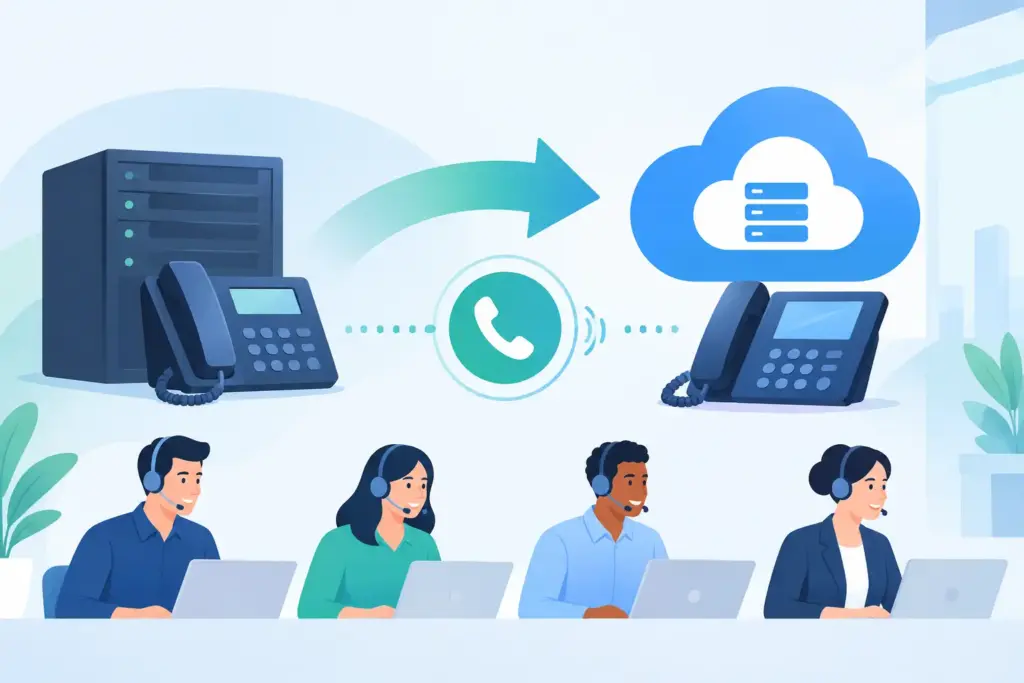
At 8:03 a.m., a PBX cutover failure is not an IT inconvenience. It is unanswered customer calls, idle contact center agents, failed emergency routes, and executives asking why the business was taken offline. A zero downtime PBX migration is designed to prevent that scenario by treating voice as a continuously available business service, not a system that can be switched off for a weekend.
For enterprises replacing legacy PBX infrastructure, consolidating locations, moving to cloud voice, or enabling carrier calling in Microsoft Teams, the real objective is continuity. Every direct inward dial number, auto attendant, hunt group, emergency calling policy, integration, and escalation path must continue operating while the underlying call-control environment changes.
What Zero Downtime PBX Migration Actually Requires
Zero downtime does not mean that nothing changes during a migration. It means users and callers do not experience an interruption in their ability to place, receive, transfer, route, or escalate calls. Achieving that outcome requires parallel service paths, controlled number porting, validated routing logic, and a rollback design that works under pressure.
A project can be technically complete and still fail operationally. For example, handsets may register successfully to a new cloud platform while a critical inbound toll-free route still points to the old carrier. A Teams user may have dial tone but lack the correct emergency location. A contact center queue may accept calls but fail to pass customer data to the CRM. These are service continuity issues, not minor configuration defects.
The migration plan must account for every voice dependency, including carrier circuits, SIP trunks, local and toll-free numbers, analog devices, paging systems, elevator lines, fax workflows, call recording, contact center routing, and third-party integrations. The more distributed the organization, the more important this inventory becomes.
Start With a Call-Flow Inventory, Not a Platform Decision
The first engineering task is to map how calls move through the organization today. That work should cover normal business-hours routing as well as after-hours, overflow, disaster recovery, and high-volume event conditions. It is common to find undocumented forwarding rules, location-specific auto attendants, or executive assistant workflows that become visible only after a migration begins.
Document each inbound number and its destination, then identify the business owner who can validate that route. Include outbound caller ID, emergency address information, voicemail behavior, failover destinations, recording requirements, and dialing permissions. For contact centers, capture queue thresholds, skills, callback treatment, supervisor workflows, and reporting dependencies.
This discovery phase is also where organizations identify technical constraints. Legacy PBXs may support analog endpoints that need adapters or replacement. Certain fax machines may need cloud fax conversion. Remote sites may require local survivability because a broadband outage cannot eliminate voice access. A zero-downtime design is not one-size-fits-all. It depends on the risk profile of each site and the operational cost of an unavailable call path.
Define the Service Baseline
Before moving traffic, establish what acceptable service looks like. Measure call completion rates, packet loss, jitter, latency, queue wait times, abandoned-call rates, and trunk utilization. These benchmarks give the project team a way to distinguish a successful cutover from a merely functional one.
For voice quality, low latency and stable packet delivery matter as much as feature configuration. The network assessment should review WAN capacity, quality-of-service policies, firewall behavior, DNS, session border controller configuration, and internet edge redundancy. Cloud voice can reduce hardware overhead, but it cannot compensate for an under-engineered access network.
Build Parallel Paths Before You Move Production Traffic
The safest migration model keeps the existing PBX operational while the target environment is deployed, configured, and tested. Users can be moved in controlled waves, while inbound traffic is routed to the appropriate platform based on number, location, department, or time of day.
Parallel operation is especially effective when paired with carrier-grade connectivity and multi-carrier redundancy. Rather than making a single irreversible routing change, the organization can validate new paths with a limited user group, test failover behavior, and expand only after success criteria are met. If a problem emerges, calls can be returned to the established service path without waiting for a vendor escalation.
For organizations adopting Microsoft Teams calling, this may mean enabling a pilot group through direct routing or operator connectivity while the legacy PBX continues to serve the broader population. For contact center modernization, it may mean running selected queues on the new platform while preserving existing customer service numbers and overflow routes.
The key is to avoid a big-bang cutover whenever the architecture allows a phased transition. A single event may look simpler on a project plan, but it concentrates operational risk into one narrow window.
Control Number Porting and Carrier Routing
Number porting is often the highest-risk moment in a PBX migration because it changes the public path customers use to reach the business. Port dates should be treated as controlled change events with named owners, carrier confirmations, test procedures, and live monitoring.
Not every number needs to port on the same day. In many cases, temporary forwarding, carrier call routing, or bring-your-own-carrier configurations can keep numbers active while services are transitioned. This flexibility is valuable for organizations with hundreds or thousands of DIDs, multiple carriers, or geographically dispersed sites.
A cutover runbook should specify who validates each call type and what constitutes a pass. Test inbound local and toll-free calling, outbound domestic and international calling where applicable, transfers, conference calls, voicemail, E911, fax, contact center queues, and calls to critical departments. Test from multiple carrier networks, not just an internal softphone.
Test Failure, Not Just Normal Operation
Many migrations test whether a call works under ideal conditions. Enterprise resilience requires testing what happens when a component does not work. Disconnect a primary route in a controlled setting. Simulate an unavailable site. Confirm that failover routes reach staffed destinations, that caller ID remains recognizable, and that administrators receive alerts.
This is where redundant carrier architecture provides business value. If a primary service path is impaired, calls should reroute automatically according to a preapproved policy. For customer-facing teams, that can mean preserving zero hold times through AI voice agents that answer, qualify, schedule, or route requests when live capacity is constrained.
Failure testing also protects emergency calling. Each user and location needs accurate emergency-service information, especially in hybrid work models where employees may place calls from offices, homes, and temporary workspaces. Emergency policies should be validated with the same rigor as inbound customer routing.
Use Wave-Based Cutovers With Clear Rollback Criteria
A disciplined zero downtime PBX migration uses deployment waves that are large enough to expose real-world conditions but small enough to contain risk. A pilot group should include different user types: reception, executives, mobile employees, power users, customer service agents, and IT support staff. Their feedback reveals practical issues that configuration reviews can miss.
Each wave needs entry criteria, success metrics, and a defined rollback point. Do not rely on vague statements such as "we will revert if there is a problem." Specify the triggering conditions: failed inbound routing, degraded audio beyond threshold, unavailable emergency calling, broken CRM screen pops, or an unresolved issue affecting a defined percentage of users.
During the cutover window, maintain a live command structure. Engineering, carrier operations, network teams, service desk leaders, and business owners should know who is authorized to make routing changes. A shared status view reduces duplicate troubleshooting and speeds decisions when minutes matter.
Operational Readiness Is Part of the Migration
The technical cutover is only one part of the project. Employees need clear guidance on new calling behavior, voicemail access, mobile applications, Teams integration, and support channels. Service desk teams need updated escalation procedures and visibility into the new platform before users begin calling for help.
Administrators also need an operating model for the environment they inherit. That includes role-based access, change control, usage reporting, number management, call analytics, security policies, and documented disaster recovery procedures. Cloud communications should centralize administration, not create another fragmented toolset.
UCC Networks approaches these programs as an engineering-led transition across voice, carrier connectivity, collaboration, contact center operations, and AI automation. The goal is not simply to replace a PBX. It is to create a communications environment that can adapt without forcing the business through another disruptive telecom project.
The Standard to Hold Your Migration Team To
A migration is ready when it can prove continuity, not when the new platform is installed. That proof comes from documented call flows, tested carrier failover, validated emergency services, monitored voice quality, informed users, and a rollback option that has been rehearsed rather than assumed.
The strongest next step is to ask a direct operational question before every cutover decision: if this route, carrier, site, or application fails right now, where does the caller go? When the answer is specific, tested, and owned, continuous uptime becomes an engineered outcome rather than a hopeful promise.