SIP Trunking for Enterprise Voice Continuity
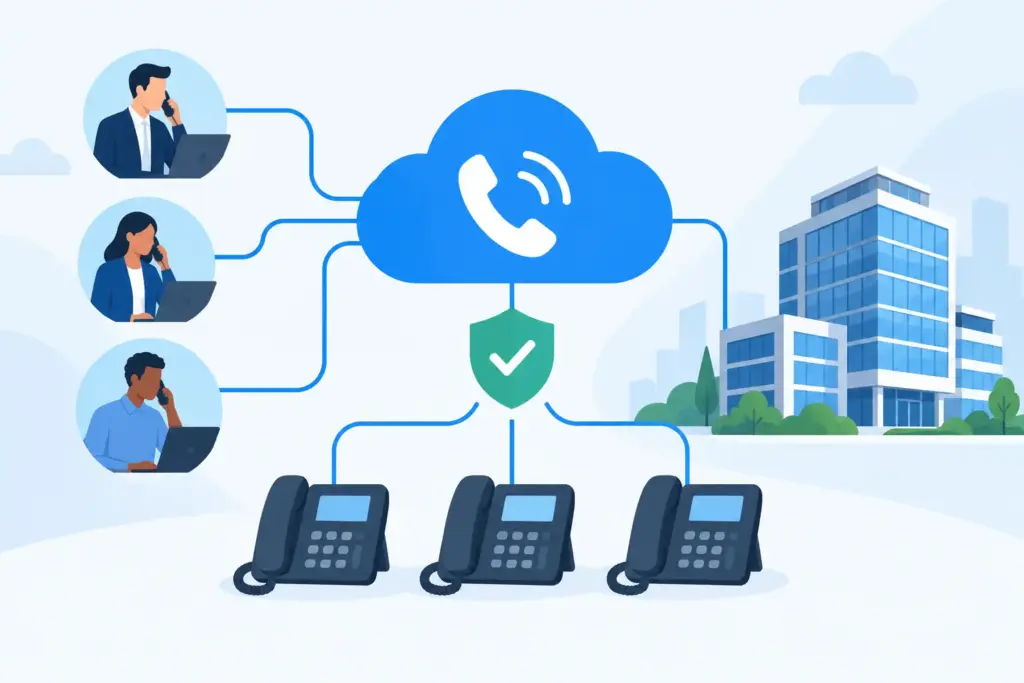
A branch office loses its local circuit at 9:07 a.m. The contact center is already handling peak call volume. Executives do not need a telecom explanation - they need inbound calls to continue reaching agents, outbound dialing to remain available, and IT to see what happened without opening five carrier tickets. That is the operational standard SIP trunking should support.
For enterprises still managing PRI lines, local analog services, separate carrier contracts, and disconnected voice systems, SIP trunking replaces physical voice circuits with IP-based carrier connectivity. The value is not simply lower per-channel costs. Properly designed, it creates a more flexible voice foundation for Microsoft Teams, cloud PBX platforms, contact centers, legacy phone systems, and AI voice automation.
What SIP Trunking Changes in Enterprise Voice
A SIP trunk is a virtual connection that carries voice sessions between an organization’s phone environment and the public telephone network. Rather than buying fixed, physical voice lines for each location, the organization provisions call capacity through an internet protocol connection.
That distinction matters when the business changes. A seasonal operation can increase capacity without installing new circuits. A company consolidating offices can retain numbers while centralizing call control. A distributed workforce can place and receive business calls through a common enterprise identity rather than relying on personal mobile numbers or disconnected local services.
The technology itself is established. The engineering decisions around it are where results differ. A low-cost trunk may provide basic dial tone, but it may not offer the routing options, survivability design, service visibility, number-management discipline, or direct support needed by a multi-site enterprise. Voice is a real-time service. Packet loss, jitter, congestion, codec selection, firewall configuration, and carrier routing policy all affect what a customer or employee hears.
For IT leaders, the right question is not, “Can we move our lines to SIP?” It is, “Can our voice architecture sustain continuous operations when a site, provider path, platform, or network condition fails?”
SIP Trunking Is Infrastructure, Not Just a Carrier Service
The strongest deployments treat SIP trunking as one component of a larger communications architecture. That architecture should connect carrier services, session border controllers, network policy, call routing, collaboration platforms, contact center workflows, and business continuity procedures.
A session border controller, or SBC, sits at a critical boundary between the enterprise environment and the carrier network. It helps secure signaling, manage media streams, normalize interoperability between systems, and enforce routing rules. In complex environments, SBC policy can determine whether calls route through a primary carrier, fail over to a secondary path, reach a local survivability resource, or redirect to another site.
Carrier redundancy is equally central. Multi-carrier design can protect voice traffic when a provider suffers an outage or routing event. Geographic diversity reduces dependence on one regional point of failure. Intelligent failover ensures the backup path is ready before an incident, not configured under pressure while customers hear busy signals.
This is especially relevant for organizations that cannot tolerate disconnected locations. Healthcare providers, financial services teams, logistics operations, property management groups, public-facing agencies, and service businesses all have calls that carry immediate operational consequences. A missed call may mean a delayed dispatch, an abandoned patient inquiry, a lost booking, or an escalated customer issue.
Capacity Planning Requires More Than Counting Users
One of the most common SIP trunking mistakes is sizing capacity according to employee headcount. A 500-person organization does not necessarily need 500 concurrent call paths. But a 100-agent contact center may require substantial capacity during predictable peaks, emergency events, or campaign launches.
Capacity should be based on concurrent call demand, including inbound queues, outbound dialing, executive and administrative calling, conference usage, emergency overflow, and growth assumptions. Teams should also account for the difference between normal traffic and the traffic pattern that occurs when systems fail over. If one location absorbs calls for three others, its available capacity must reflect that scenario.
Call paths are only part of the calculation. Bandwidth and network quality matter just as much. A high-definition voice call consumes a modest amount of bandwidth, but dozens or hundreds of simultaneous calls require deliberate WAN and internet design. Quality of service policies should prioritize real-time media where the network supports them. Network monitoring should identify loss, latency, and jitter before the help desk becomes the first detection system.
There is also a trade-off between public internet transport and dedicated connectivity. Public internet can be efficient and flexible, particularly with diverse circuits and carefully managed edge infrastructure. Dedicated private connectivity can provide more predictable transport for environments with strict performance or compliance requirements. The appropriate design depends on the application, location profile, risk tolerance, and existing network estate.
Integration Determines Whether Voice Becomes Simpler
SIP trunking delivers its greatest business value when it reduces fragmentation instead of moving it to a different provider. Enterprise teams often need carrier calling to work across Microsoft Teams, Cisco environments, Zoom, Genesys, 8x8, cloud contact centers, and on-premises PBX systems during a staged transition.
For Microsoft Teams, carrier-grade PSTN connectivity can give users direct business calling inside the collaboration client they already use. IT retains control over number assignment, routing, emergency calling, policy, and reporting while employees avoid switching between separate communications tools. This model is particularly useful for organizations standardizing on Teams but not ready to abandon every existing voice workflow at once.
Contact center integration deserves its own design review. An inbound number may need to route first through an AI voice agent, then to a skills-based queue, then to an overflow team or external answering service. The carrier layer must preserve caller identity, support reliable transfers, and apply routing rules without introducing unnecessary delay.
Consider a service organization handling appointment requests. An AI voice agent can answer immediately, understand the reason for the call, schedule an available time, and transfer exceptions to the correct team. SIP connectivity supports the call path behind that experience. When the voice carrier, automation layer, and contact center are designed separately, customers often encounter repeated prompts, failed transfers, or queue loops. When they are engineered as one environment, the result is faster resolution and zero hold times for many routine requests.
Migration Should Protect Business Continuity
Replacing legacy voice services is rarely just a technical cutover. Numbers may be printed on vehicles, customer documents, websites, medical records, storefront signage, and long-standing client contact lists. A migration plan has to preserve those numbers, verify emergency service records, test routing behavior, and define exactly what happens if porting dates or carrier orders change.
A zero-downtime migration starts with discovery. Inventory every number, circuit, PBX, call flow, fax dependency, alarm line, elevator phone, and analog exception. Identify which services can move first and which require a transitional design. Not every legacy endpoint should be forced into the new platform on day one.
Testing must include more than a few successful inbound calls. Teams should validate outbound dialing, toll-free numbers, international patterns where applicable, caller ID presentation, call recording, fax workflows, emergency dialing, failover behavior, and access from every major location. They should test what happens when the primary WAN link fails, when a platform connector is unavailable, and when a receiving site reaches capacity.
The port itself should be scheduled as an operational event. Assign owners for carrier coordination, user communications, command-center monitoring, and escalation. Keep temporary forwarding and rollback options available where practical. The goal is not merely to complete the port order. It is to keep customers and employees connected throughout the change.
The Questions Enterprise Teams Should Ask
Before selecting a SIP trunking provider, technology leaders should examine the operating model behind the service. Ask how the provider delivers redundancy, whether it operates a carrier-grade network, how it monitors call quality, and who owns escalation when a call-routing issue crosses carrier and platform boundaries.
Also ask whether the provider can support mixed environments. A business may need Teams calling at headquarters, a Cisco estate at manufacturing sites, a legacy PBX during a merger, and a cloud contact center for customer service. A provider that only supports a single product may turn a practical migration into an unnecessary rip-and-replace project.
Finally, clarify support expectations. Commodity voice service can leave internal IT teams coordinating between carriers, software vendors, and network providers during an outage. An engineering-led partner should help isolate the fault domain, interpret signaling and call traces, adjust routing when required, and keep accountable ownership through resolution.
UCC Networks approaches SIP trunking as part of an integrated voice strategy, combining carrier connectivity, multi-carrier redundancy, platform integration, and direct engineering support. That approach is designed for organizations where communications uptime is tied directly to customer experience and daily operations.
The most valuable next step is to map one real call journey - from a customer dialing your main number through routing, automation, queueing, transfer, and final resolution. The gaps in that journey will show whether your current voice environment is simply connected or truly prepared to perform under pressure.