Operator Connect vs Direct Routing Compared
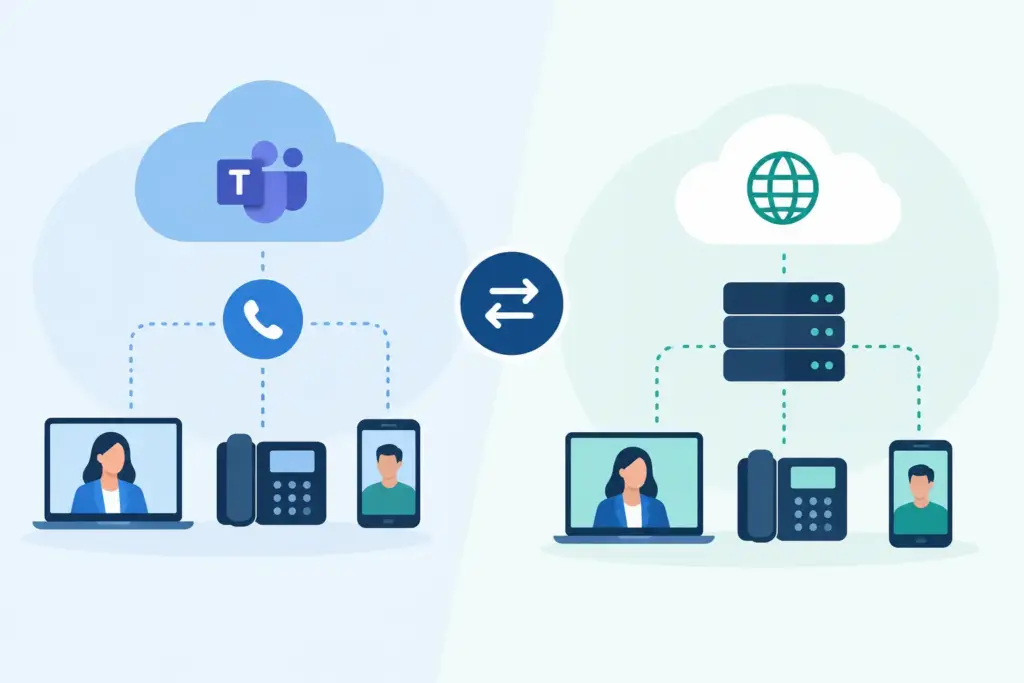
A Microsoft Teams calling decision becomes visible the first time a customer call fails to reach the right queue, a site needs local emergency calling, or a carrier migration threatens a business day. Operator Connect vs Direct Routing is not simply a feature comparison. It is a decision about who owns the voice edge, how much control IT retains, and how quickly the organization can adapt its calling environment without compromising uptime.
For enterprises standardizing on Teams, both options replace isolated PBX infrastructure with carrier calling inside the collaboration platform employees already use. The right choice depends on existing carrier commitments, geographic requirements, contact center design, security policy, and the operational maturity of the team that will support it.
Operator Connect vs Direct Routing: the core difference
Operator Connect is Microsoft Teams calling delivered through a participating carrier that has integrated directly with Microsoft. IT selects an operator, acquires numbers and calling services, and assigns users through the Teams Admin Center. The operator manages the connection between its network and Microsoft Teams.
Direct Routing connects Teams to the public telephone network through a certified Session Border Controller, or SBC. The SBC can be hosted in the enterprise, delivered as a managed cloud service, or deployed in a hybrid model. It gives the organization or its communications partner direct control over call routing between Teams, carriers, legacy voice systems, analog devices, contact centers, and business applications.
The distinction matters because an Operator Connect deployment is designed for speed and simplified administration, while Direct Routing is designed for architectural flexibility. Neither approach is inherently better. A distributed organization with straightforward Teams users may favor the faster operational path. A business with multiple carriers, specialized routing rules, acquired sites, or a complex contact center usually needs the control Direct Routing provides.
Where Operator Connect performs best
Operator Connect reduces the amount of voice infrastructure an internal IT team needs to manage. There is no customer-managed SBC to size, configure, patch, or monitor. For organizations moving from a conventional phone system to Teams calling, that can shorten deployment timelines and reduce the number of operational handoffs.
Its administration model is also familiar to Teams administrators. User enablement, number assignment, and operator selection are centralized in the Teams environment, while the carrier handles PSTN connectivity. This structure works particularly well when the carrier has coverage in every required country or region and the organization does not need unusual dial-plan logic.
The model has practical limits. Operator availability, number inventory, porting processes, supported countries, and service features vary by provider. If a company needs to preserve a preferred regional carrier, integrate a legacy PBX during a staged migration, or route different call types through different networks, the choices may narrow quickly. Simplified does not mean standardized in every market.
Operator Connect can also place more of the service experience in the hands of a single operator. That may be appropriate when the provider meets the enterprise's support, resiliency, compliance, and escalation requirements. It requires diligence during evaluation: ask how outages are handled, what redundancy exists beyond the Teams interconnection, and how number ports, emergency locations, and service changes are governed.
Where Direct Routing creates an advantage
Direct Routing is the better fit when calling is part of a wider communications architecture rather than a standalone Teams service. The SBC becomes a controlled policy point for carrier selection, number normalization, least-cost routing, failover, security, and interoperability.
That flexibility is especially valuable in organizations that operate across multiple locations or business units. A health system may need to retain local numbers and paging systems. A manufacturer may need Teams users, plant phones, overhead paging, and analog lines to coexist. A financial services organization may require defined voice routes, carrier diversity, and documented controls across regions. Direct Routing can accommodate these realities without forcing every calling workflow into a single operator model.
It also supports deliberate carrier strategy. Enterprises can maintain existing contracts, use different carriers by geography, or design primary and secondary PSTN paths. Carrier diversity does not eliminate every failure scenario, but it can reduce dependence on one provider and give network teams more options during an incident.
The trade-off is responsibility. Direct Routing requires SBC engineering, certificate management, routing design, monitoring, capacity planning, and incident ownership. A managed service can remove much of that burden, but the provider should be able to demonstrate carrier-grade infrastructure, active monitoring, clear escalation paths, and tested business continuity procedures. A poorly designed SBC environment is not more flexible in practice. It is simply another point of failure.
Cost is a lifecycle question, not a per-user question
Operator Connect often appears simpler to price because the carrier service is bundled around users, numbers, and calling plans. Direct Routing may have more visible components: SBC services, carrier circuits or trunks, implementation engineering, and managed support. Looking only at monthly seat pricing can lead to the wrong decision.
The useful comparison is total operating cost over the expected life of the environment. Include existing carrier contracts, local and international calling patterns, number porting, support requirements, migration complexity, contact center integration, and the cost of maintaining duplicate systems during transition. A lower initial price can become expensive if it requires a later redesign to support acquired sites or new call flows.
For large call volumes, Direct Routing may create meaningful carrier and routing options. For a relatively uniform user population with limited telephony complexity, Operator Connect may avoid infrastructure costs that provide little additional value. The answer changes with scale and architecture.
Design for resilience before choosing a route
Teams calling availability depends on more than the method used to reach the PSTN. Internet access, local network quality, endpoint configuration, identity services, carrier availability, emergency calling configuration, and operational response all affect the experience.
With Operator Connect, resilience questions center on the operator's network design, service-level commitments, geographic coverage, and support model. With Direct Routing, the assessment must also include SBC high availability, geographic redundancy, carrier failover, DNS design, and survivability plans for sites that lose connectivity.
Voice quality deserves equal attention. Low-latency audio is an end-to-end outcome, not a carrier label. Network readiness assessments, quality-of-service policies, WAN capacity, and continuous monitoring are essential whether the PSTN path is operator-managed or SBC-managed. The objective is not merely to place a call. It is to preserve a reliable call path when the network is under pressure.
Migration and coexistence are often the deciding factors
Many enterprises do not move every user, number, and workflow to Teams at once. They may have an existing PBX, a contact center platform, elevator phones, fax dependencies, analog endpoints, or contractual carrier obligations. In these environments, Direct Routing commonly offers a cleaner transition because it can bridge old and new systems while numbers and departments move in phases.
Operator Connect can be an efficient destination for a simpler migration, particularly when the organization can port numbers directly and retire legacy infrastructure quickly. But if the project requires temporary coexistence, custom routing, or separate migration waves across regions, validate that model before committing.
A zero-downtime migration is achieved through planning, not a product selection checkbox. Inventory every number, define porting windows, test inbound and outbound paths, confirm emergency calling behavior, and establish rollback procedures. Executive confidence comes from controlled cutovers and visible accountability.
A practical decision framework
Choose Operator Connect when your priority is a fast Teams calling rollout, your preferred operator has the right geographic coverage, and your voice requirements are relatively consistent. It is a strong option for IT teams that want centralized Teams administration without operating SBC infrastructure.
Choose Direct Routing when Teams must coexist with existing communications systems, carrier strategy is a business requirement, or routing must adapt to multiple locations, contact centers, applications, and compliance policies. It is also the stronger long-term foundation when voice architecture needs to remain under enterprise control.
A hybrid approach can be valid. Some organizations use Operator Connect for standard knowledge-worker calling while using Direct Routing for contact centers, regulated locations, acquired businesses, or complex regional requirements. The governing principle is to avoid fragmented administration and unclear ownership. Every route should have a defined support model, monitoring plan, and failover behavior.
UCC Networks evaluates these decisions as an operating model, not a licensing exercise. The most effective Teams calling environment aligns carrier connectivity, SBC design, migration sequencing, and service support with the way the business actually communicates.
The right architecture is the one that keeps employees productive, customers out of queues, and IT in control when a routine call becomes an operational event.