Multi Carrier Voice Redundancy for Uptime
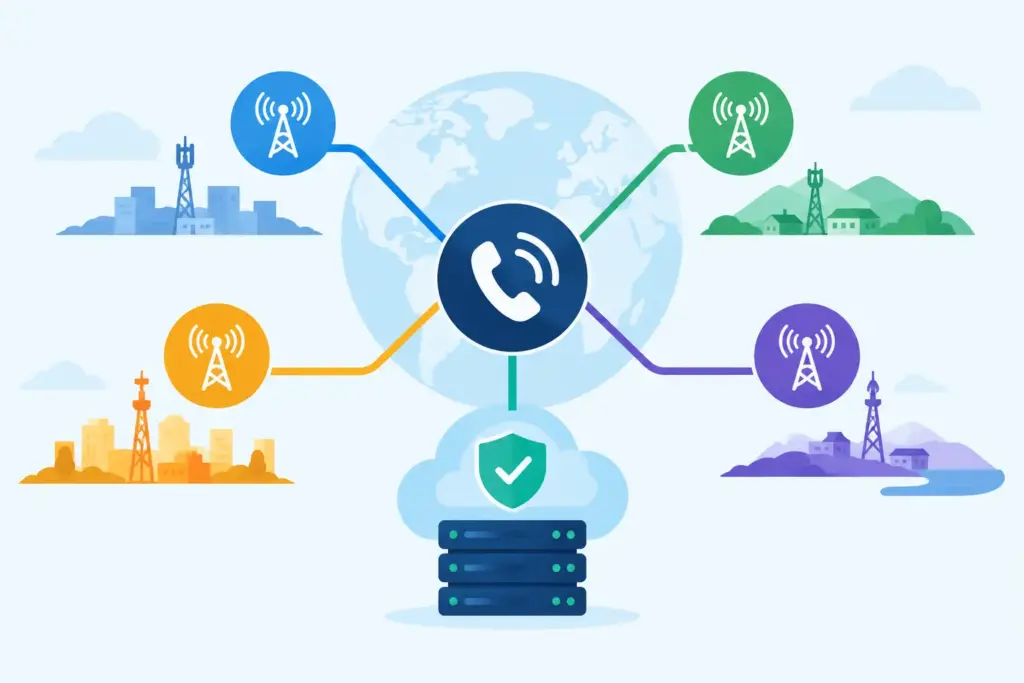
A carrier outage rarely announces itself in advance. It appears as calls that will not complete, one-way audio, failed emergency routing, or a contact center queue that suddenly goes silent. Multi carrier voice redundancy is the architecture that prevents a single carrier event, network fault, or geographic disruption from becoming a business interruption.
For enterprises that depend on voice for revenue, patient access, field dispatch, financial service, or customer support, redundancy is not a feature added after deployment. It is a design decision that determines whether communications remain available when the primary path does not.
Voice Resilience Is an Architecture Decision
Many organizations believe they have redundancy because they operate several office locations, use cloud calling, or maintain a backup internet circuit. Those measures can help, but they do not automatically protect calling. A cloud phone platform still depends on carrier interconnection, number routing, session border controllers, DNS resolution, network paths, and endpoint registration.
If several of those functions rely on the same upstream provider or geographic point of presence, the environment can retain a hidden single point of failure. The result is an outage that is technically outside the company network but operationally very much inside the business.
Carrier-grade voice resilience separates the components that can fail together. It uses independent carrier paths, distinct interconnects, intelligent routing controls, and active monitoring to keep calls moving. The goal is not merely to have a secondary provider on paper. The goal is to make failover fast, controlled, and verifiable under real operating conditions.
How Multi Carrier Voice Redundancy Works
Multi carrier voice redundancy places more than one carrier behind enterprise voice services. When a carrier, route, or regional connection is degraded, calls are redirected through a healthy path based on defined routing policy and real-time availability.
This architecture can support inbound and outbound calling, toll-free services, contact center traffic, Microsoft Teams calling, SIP trunks, and legacy PBX environments. The exact design depends on call volume, number inventory, compliance requirements, office geography, and the cost of downtime to the organization.
Diverse carriers matter more than duplicate contracts
Buying service from two carriers is a starting point, not a complete continuity strategy. True diversity requires examining whether providers share underlying facilities, data centers, interconnection points, last-mile access, or routing dependencies. Two invoices do not guarantee two independent paths.
A properly engineered environment evaluates carrier diversity at the network and geographic levels. For distributed organizations, that may mean assigning preferred and alternate routes by region, protecting critical sites with separate access providers, and maintaining alternate termination paths for high-volume inbound numbers.
Routing policy determines the customer experience
Failover should not be left to a generic default. Routing policy needs to reflect how the organization operates. A healthcare organization may prioritize patient scheduling and urgent clinical lines. A logistics company may preserve dispatch traffic. A financial services firm may need specific number presentation, recording, and regional routing controls to remain intact during a failover event.
The best policy is often selective rather than absolute. During a carrier degradation, an enterprise may route priority queues through the alternate carrier while less critical outbound traffic uses capacity controls. This protects the calls that matter most without creating a secondary capacity problem.
Design for Actual Failure Modes
Voice failures are not all the same, and a resilient design accounts for the difference. A carrier-wide outage calls for different action than a local internet failure. A degraded route with intermittent call setup failures requires different handling than a complete SIP registration loss.
A mature design considers carrier interruption, regional network events, damaged last-mile circuits, DNS problems, session border controller failure, cloud availability zone disruption, and endpoint connectivity issues. It should also account for human error, including an incorrect route change or failed configuration deployment.
This is why continuous uptime requires layers. Carrier redundancy protects the carrier layer. Diverse access circuits protect site connectivity. Redundant session border controllers protect call control. Geographic separation protects against localized events. Active monitoring detects when a path is technically available but delivering poor call quality.
Each layer has a different job. Treating them as interchangeable leads to gaps that only become visible during an incident.
Capacity Is the Test Many Backup Plans Fail
A secondary carrier path is only useful if it can carry the traffic transferred to it. Enterprises often size backup capacity for a small percentage of normal traffic, then discover that a major event shifts thousands of concurrent calls toward a path designed for a fraction of that load.
Capacity planning should be based on busy-hour concurrent call volume, not average daily usage. It should include contact center spikes, seasonal demand, emergency calling requirements, outbound campaign traffic, and the bandwidth consumed by high-definition voice. Call admission controls should prevent lower-priority traffic from exhausting capacity needed by critical teams.
There is a cost trade-off. Fully duplicating peak capacity across every carrier may be unnecessary for some organizations. Others cannot accept any degradation in customer access or dispatch operations. The right approach depends on recovery objectives, service-level commitments, and the financial impact of missed calls. Engineering should make those trade-offs explicit before an outage forces the decision.
Multi Carrier Voice Redundancy for Teams and Contact Centers
Microsoft Teams has become a primary calling interface for many enterprises, but Teams adoption does not eliminate the need for voice architecture. Carrier routing, direct connectivity, emergency services, number management, and business continuity still require deliberate design.
With a properly integrated carrier model, Teams users can continue making and receiving business calls even when a preferred route is unavailable. Contact centers can preserve inbound access while calls are directed to alternate agents, overflow groups, or AI voice agents that answer routine requests without hold times.
The same principle applies to environments that combine Cisco, Zoom, Genesys, 8x8, legacy PBX systems, and cloud UC platforms. Organizations do not need to complete every migration before improving resilience. A phased architecture can protect current services while creating a controlled path toward consolidation.
Monitoring Must Measure Call Quality, Not Just Availability
A green status light can hide a poor customer experience. A SIP trunk may appear reachable while calls suffer elevated post-dial delay, failed transfers, jitter, packet loss, or one-way audio. For a contact center, those conditions can be nearly as damaging as a hard outage.
Operational monitoring should track call setup success, failure codes, quality metrics, route performance, concurrent sessions, carrier response patterns, and failover activity. Teams need alert thresholds that identify deterioration early, before callers report the problem.
Monitoring also needs an ownership model. When an issue crosses the enterprise network, cloud platform, carrier, and contact center stack, commodity support workflows can slow resolution. Direct engineering support and clear escalation paths reduce the time spent proving where the fault resides.
Failover Requires Testing and Change Discipline
A redundancy design that has never been tested is an assumption. Scheduled tests validate that alternate carriers accept traffic, routing rules activate as intended, caller ID behavior remains correct, emergency calling policies are preserved, and support teams know how to respond.
Testing should include partial failures, not only full outages. Simulate degraded carrier performance, unavailable regional routes, lost site connectivity, and a failed voice edge. Document the expected behavior for each scenario and compare it with actual results.
Change management matters just as much. New numbers, dial plan adjustments, contact center changes, and platform migrations can quietly bypass established resiliency controls. Voice architecture should be reviewed whenever the organization adds sites, changes carriers, expands Teams calling, or modifies critical customer workflows.
Build Continuity Into the Communications Roadmap
Multi-carrier design is most effective when it supports a broader communications strategy rather than operating as an isolated telecom project. It can reduce dependency on legacy contracts, simplify the move to cloud voice, protect customer experience during modernization, and provide a stronger foundation for AI-assisted call handling.
UCC Networks approaches this work as operational infrastructure: carrier-grade connectivity, tested failover paths, integrated calling environments, and engineering-led migration plans designed to avoid disruption. The objective is not simply another backup route. It is a communications environment that continues serving employees and customers when the expected path is no longer available.
The most useful next step is to map the voice services your business cannot afford to lose, identify every dependency behind those calls, and test whether your current alternate path can carry the load. That exercise turns uptime from a vendor promise into an operational capability.