Cisco PBX Cloud Migration Without Downtime
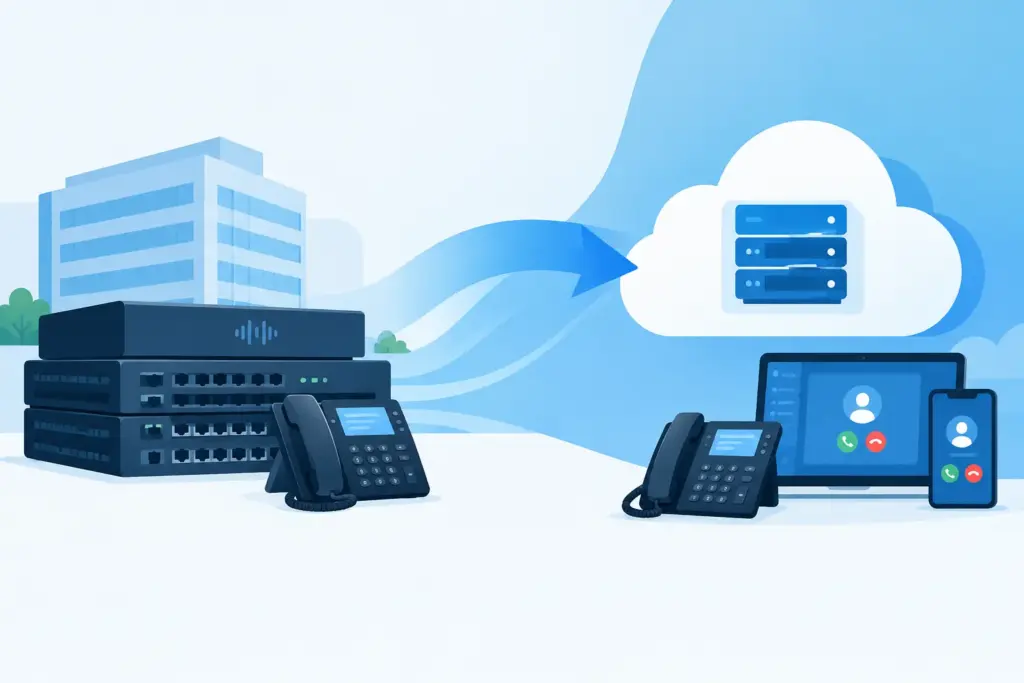
A Cisco PBX cloud migration is rarely a phone-system replacement. For an enterprise with branch offices, customer queues, regulated workflows, and thousands of published numbers, it is a continuity project. The goal is not simply to move calling to the cloud. It is to modernize the voice architecture while protecting every critical call path, from front-desk routing to emergency services and contact center escalation.
The organizations that achieve the best outcome treat migration as an engineering program, not a licensing exercise. They map dependencies before changing dial tone, establish parallel service paths, and cut over in controlled waves. That discipline turns cloud voice into a platform for centralized administration, Microsoft Teams calling, AI voice automation, and carrier-grade resilience without asking the business to absorb avoidable disruption.
Why Cisco PBX Cloud Migration Needs an Architecture Plan
Cisco environments are often deeply embedded in operations. Cisco Unified Communications Manager may support complex dial plans, survivability gateways, analog devices, paging systems, executive call handling, contact centers, and integrations that were built over years. Replacing the core calling platform without accounting for those dependencies can create gaps that only appear when a site loses connectivity or a high-volume customer queue spikes.
A cloud strategy should begin with a practical decision: what must remain local, what should move to cloud services, and what can be retired. A distributed manufacturer may need local survivability for facilities with inconsistent WAN performance. A professional services firm may prioritize Teams-native calling and mobile workforce flexibility. A healthcare or financial organization may place greater weight on recording, retention, emergency calling, and access controls.
There is no universal target architecture. A full replacement can simplify administration and reduce data center overhead, but a hybrid design may be the lower-risk path for organizations with specialized Cisco workflows or site-specific hardware. The right design is the one that improves operational control while preserving required functionality on day one.
Start With Call-Flow Discovery, Not User Counts
User counts are useful for licensing and budgeting. They do not tell you how voice actually moves through the organization. A credible discovery process documents inbound numbers, carrier services, auto attendants, hunt groups, emergency locations, call recording, fax, analog endpoints, integrations, and failover rules.
The highest-risk dependencies tend to sit outside the desktop phone population. Think elevator and alarm lines, overhead paging, door entry systems, credit-card terminals, fax workflows, and emergency notification systems. Some can transition to IP-based services. Others may require an analog gateway, adapter, or a retained local service. Treating them as exceptions late in the project is how a migration becomes disruptive.
Call-flow discovery should also identify business ownership. IT may own the platform, but reception, customer support, facilities, compliance, and regional operations often own the consequences of a routing change. Their requirements need to be captured before a new auto attendant or IVR is designed.
Build for Continuous Uptime, Not a Single Carrier Path
Moving PBX functionality to the cloud does not remove network risk. It changes where resilience must be designed. An enterprise cloud voice deployment needs a clear answer to a basic question: if a carrier circuit, site firewall, cloud region, or routing provider fails, how do employees and customers continue communicating?
Carrier-grade infrastructure starts with diverse connectivity and multiple routing options. SIP services should be engineered with redundant carrier paths, geographic failover, and number-routing controls that can redirect inbound traffic when a location or platform is unavailable. For critical locations, WAN design, QoS policy, local gateway strategy, and cellular or secondary broadband backup all matter.
Voice quality also depends on more than available bandwidth. Packet loss, jitter, firewall inspection, and poorly prioritized traffic can degrade calls even on a fast circuit. Pre-migration network assessment should measure these conditions at each site and define the remediation needed for low-latency audio. Monitoring should continue after cutover, because degradation is often intermittent and location-specific.
Emergency calling requires equal rigor. Every location must have accurate dispatchable address information, and remote or hybrid workers need a process for updating their emergency location. This is an operational responsibility, not a one-time configuration task.
Choose the Cloud Calling Model Around How Teams Work
For many enterprises, Microsoft Teams is already the collaboration layer employees use all day. Bringing carrier calling into Teams can reduce application switching and simplify the end-user experience. It can also create a more coherent operating model when chat, meetings, presence, SMS, and voice are administered under connected policies.
That does not mean every Cisco feature should be forced into Teams. Contact center routing, specialized attendant consoles, legacy devices, and complex site survivability may require dedicated components. The objective is to integrate the tools people rely on, not to create a visually tidy architecture that fails real-world workflows.
A modern cloud voice design can also extend beyond employee calling. AI voice agents can answer routine inbound calls, recognize natural speech, capture service requests, schedule appointments, route urgent issues, and provide status information without placing callers into a queue. For customer-facing operations, that means fewer abandoned calls and a credible path toward zero hold times for high-volume, repeatable interactions.
The best use cases are specific. A voice agent that handles after-hours scheduling or first-line service triage is easier to govern and measure than an agent asked to handle every conversation from launch. Establish escalation rules, audit interactions, and keep a clear path to a live employee when the request requires judgment or sensitive handling.
Execute a Phased Cisco PBX Cloud Migration
A zero-downtime migration is created through sequencing. Number porting, user activation, call routing, device provisioning, and carrier failover should not all occur in one high-stakes event. A phased approach creates room to validate each layer before it becomes business-critical.
A typical enterprise program moves through four controlled stages:
- Architecture and discovery: Document call flows, network readiness, compliance requirements, integrations, carrier inventory, and every special endpoint.
- Pilot and validation: Move a representative group, test inbound and outbound calling, validate emergency services, and confirm quality across office, remote, and mobile networks.
- Wave-based deployment: Transition departments or locations in planned groups, using dual routing or coexistence where appropriate to preserve service during the change.
- Optimization and retirement: Tune routing, reporting, Teams policies, AI workflows, and support processes before decommissioning legacy infrastructure and contracts.
The pilot should include difficult conditions, not only cooperative office users. Test remote staff, high-call-volume teams, mobile clients, executive assistants, inbound toll-free traffic, after-hours routing, and failover scenarios. If an issue cannot be reproduced before rollout, it becomes harder to isolate when hundreds of users are involved.
Number porting deserves its own runbook. Port dates, routing responsibilities, rollback options, customer-facing communications, and escalation contacts need to be explicit. In many cases, temporary forwarding or parallel carrier routing can protect inbound service while porting is completed. The exact method depends on number ownership, carrier arrangements, and the existing PBX design.
Measure Business Outcomes After Cutover
A migration is not finished when users can place calls. Leadership should be able to see whether the new environment is improving the cost, reliability, and speed of communications.
Track call quality by location, inbound answer rates, abandoned calls, average queue time, service availability, carrier incidents, support ticket volume, and time required to make administrative changes. For customer operations, measure the containment and escalation performance of AI voice workflows alongside customer satisfaction and resolution outcomes. These metrics distinguish a cloud deployment that merely works from one that reduces operational friction.
Centralized administration is often an immediate benefit. Changes that once required separate carrier tickets, PBX updates, and local site coordination can be governed through a defined operating model. But centralization should not become a bottleneck. Establish role-based access, approval paths, and documented standards so regional teams can act quickly within enterprise controls.
Make Migration a Platform Decision
The strongest cloud voice programs do more than retire aging PBX hardware. They create a communications foundation that can adapt as the organization changes - new locations, acquisitions, remote workforce policies, evolving customer expectations, and increasing demand for automated service.
UCC Networks approaches this work as a communications architecture engagement, combining carrier connectivity, Teams integration, cloud voice engineering, and AI automation around the operating requirements of the business. The practical question is not whether cloud calling can replace a Cisco PBX. It is whether the new environment can carry the organization through its next outage, growth cycle, and customer-service surge with greater control than the one it replaces.
Begin by identifying the call paths your business cannot afford to lose. Once those are protected by design, the migration can become a controlled modernization effort instead of a risky change to the system everyone notices only when it stops working.