How to Automate Inbound Calls Without Losing Control
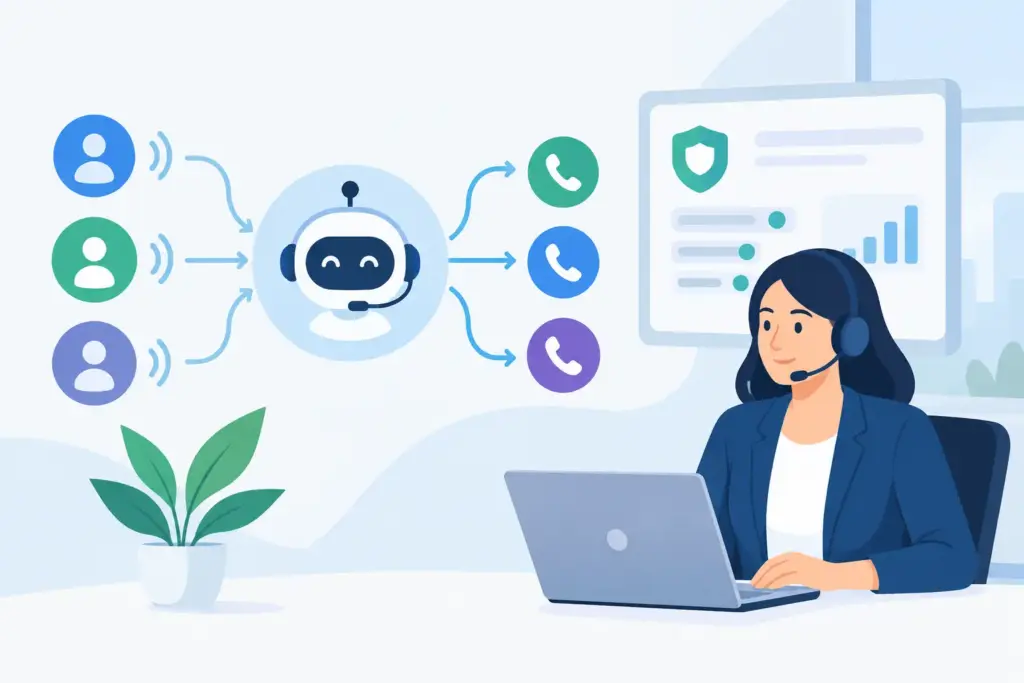
A customer calling to reschedule a field visit should not have to wait behind a billing question, a sales inquiry, and an after-hours emergency. Yet that is exactly what happens when every inbound call follows the same queue. Learning how to automate inbound calls is not about replacing the phone system with a recording. It is about designing an always-on voice operation that understands intent, takes action, and brings the right person into the conversation only when human judgment is required.
For enterprise organizations, the target is straightforward: zero hold times for routine requests, faster resolution for high-value or urgent interactions, and centralized control over how calls move across teams, locations, and systems. Achieving it requires more than selecting an AI voice tool. It requires call-flow design, reliable carrier connectivity, integration discipline, and a clear escalation model.
Start With the Calls That Create the Most Friction
The fastest path to value is not automating every call on day one. Begin with the high-volume, repeatable interactions that consume agent time but do not consistently require a live conversation. Appointment scheduling, order status, payment reminders, store hours, basic account updates, password-reset guidance, lead qualification, and after-hours service intake are common candidates.
Review call recordings, queue reports, and agent disposition data for the previous 60 to 90 days. Look beyond average handle time. The more useful signals are abandonment rate, transfer rate, after-hours volume, repeat callers, and the percentage of requests resolved using the same small set of answers or actions.
A practical automation plan separates calls into three paths. The first is fully automated resolution, where the voice agent can authenticate the caller, complete the task, and confirm the outcome. The second is assisted automation, where AI gathers context before transferring the call with a complete interaction summary. The third is direct routing for situations such as safety incidents, legal matters, complex account disputes, or high-value customer escalations.
That distinction protects the customer experience. A caller should never be forced through automation when urgency, emotion, or policy requires a trained person.
How to Automate Inbound Calls With an Intent-First Design
Traditional IVR menus make callers translate their needs into numbered options. Intent-first automation reverses that burden. The caller states the reason for the call in natural language, and the system identifies the request, gathers required information, and determines the next best action.
For example, a facilities services organization might receive: “The air conditioning is down in our server room.” A capable voice agent should recognize a potential critical incident, confirm the site and callback number, create or update a service ticket, notify the on-call team, and keep the caller informed. Routing that call to a generic menu would add delay exactly when the operation needs speed.
Each automated call flow should define four elements: the caller intent, the data needed to resolve it, the approved action the system can take, and the escalation condition. This is where many deployments either succeed or fail. An AI agent may understand what a caller means, but it must also have a governed path to perform useful work.
Build for real conversation, not perfect scripts
Callers interrupt, change topics, use incomplete details, and speak differently than internal teams label issues. Design prompts around natural exchanges rather than rigid scripts. The system should ask one focused question at a time, confirm critical information, and gracefully recover when it cannot confidently interpret a response.
Confidence thresholds matter. If the AI is uncertain whether a caller is reporting a medical emergency, a security issue, or a routine maintenance request, escalation should be immediate. Automation earns trust by knowing when not to automate.
Connect the agent to systems of record
An automated voice agent becomes operationally valuable when it can securely interact with the platforms where work happens. Depending on the use case, that may include CRM records, scheduling tools, service-management systems, payment platforms, knowledge bases, identity services, or contact center applications.
A caller asking for an appointment change should not receive a promise that someone will call back if the system can check availability and reschedule in the same interaction. Conversely, do not grant broad system access merely for convenience. Use least-privilege permissions, authenticated workflows, audit logs, and clearly defined transaction limits.
Make Intelligent Routing Part of the Architecture
Automation does not eliminate live agents. It makes them more effective by ensuring the calls that reach them arrive with context and purpose. Intelligent routing should account for intent, customer tier, language, location, business hours, agent skills, queue conditions, and incident severity.
For organizations operating in Microsoft Teams, Cisco, Zoom, Genesys, 8x8, or a mixed legacy PBX environment, the routing layer must work across the communications estate. A fragmented deployment can create new dead ends: the AI answers in one platform, while the right specialist is available in another.
When a transfer is necessary, pass the conversation summary with it. The receiving employee should see who called, why they called, what the agent verified, actions already taken, and the reason automation escalated. Requiring a caller to repeat this information undermines the operational gains of automation.
The transfer itself should also be resilient. Set overflow rules for unavailable teams, after-hours coverage, regional failover, and critical-event routing. A routing model that works only under normal queue conditions is not enterprise-ready.
Treat Voice Reliability as a Core Requirement
An AI voice experience is only as dependable as the telecom foundation below it. Low-latency audio, carrier diversity, geographically resilient routing, number management, QoS controls, and active network monitoring all influence whether an automated call feels immediate or unreliable.
This is especially relevant when inbound automation supports revenue, emergency response, dispatch, patient access, financial servicing, or distributed operations. A delayed answer, one-way audio issue, or failed transfer is not merely a technical defect. It is a missed customer interaction or an operational risk.
Carrier-grade infrastructure should include multi-carrier redundancy and defined failover behavior. Test what occurs if a carrier path, cloud region, integration endpoint, or office network becomes unavailable. The correct answer is not simply “the call fails over.” Teams need to know where it goes, what data persists, who is alerted, and how the caller experience changes.
For complex environments, deploy in phases. Start with a limited call type or business unit, monitor performance, refine prompts and policies, then expand. A zero-downtime migration approach protects business continuity while allowing teams to validate real caller behavior before broad rollout.
Measure Resolution, Not Just Deflection
A low transfer rate can look impressive while masking poor outcomes. If callers abandon the interaction, call back later, or use a different channel because the voice agent failed to solve the issue, the automation is creating hidden cost.
Use a scorecard that combines customer and operational measures. Track containment rate, but pair it with first-call resolution, abandonment, average time to resolution, escalation accuracy, callback rate, sentiment where appropriate, and transfer completion. For transactional workflows, measure whether the desired action was actually completed: was the appointment booked, the ticket created, the payment posted, or the case routed to the correct owner?
Review a sample of automated conversations regularly. Operations leaders, contact center managers, IT, and compliance teams should examine misunderstood intents, failed integrations, unnecessary transfers, and exceptions that agents handled manually. Those observations become the next set of improvements.
Governance also needs ownership. Assign responsibility for call-flow changes, knowledge updates, integration permissions, monitoring thresholds, and incident response. A voice agent is not a one-time deployment. It is an operational system that needs the same discipline applied to contact center routing, identity controls, and production applications.
Choose Automation That Fits the Enterprise
The right platform depends on call volume, integration depth, regulatory requirements, existing collaboration tools, and tolerance for operational complexity. A small business may accept a basic hosted IVR. An enterprise with distributed sites and high inbound volume needs a more deliberate design that unifies carrier services, voice AI, routing, administration, and support.
UCC Networks approaches this as communications infrastructure rather than a standalone bot project. AI voice automation, cloud telephony, Microsoft Teams calling, contact center workflows, and carrier connectivity must operate as one controlled environment if the organization expects continuous uptime and consistent service.
The most effective inbound automation does not make customers feel processed. It gives them a faster path to an answer, a completed task, or the right expert. Start with a call journey where delay has a measurable cost, engineer the escalation path as carefully as the automated path, and let the results determine where automation expands next.