How Do AI Voice Agents Work in Enterprise Calls?
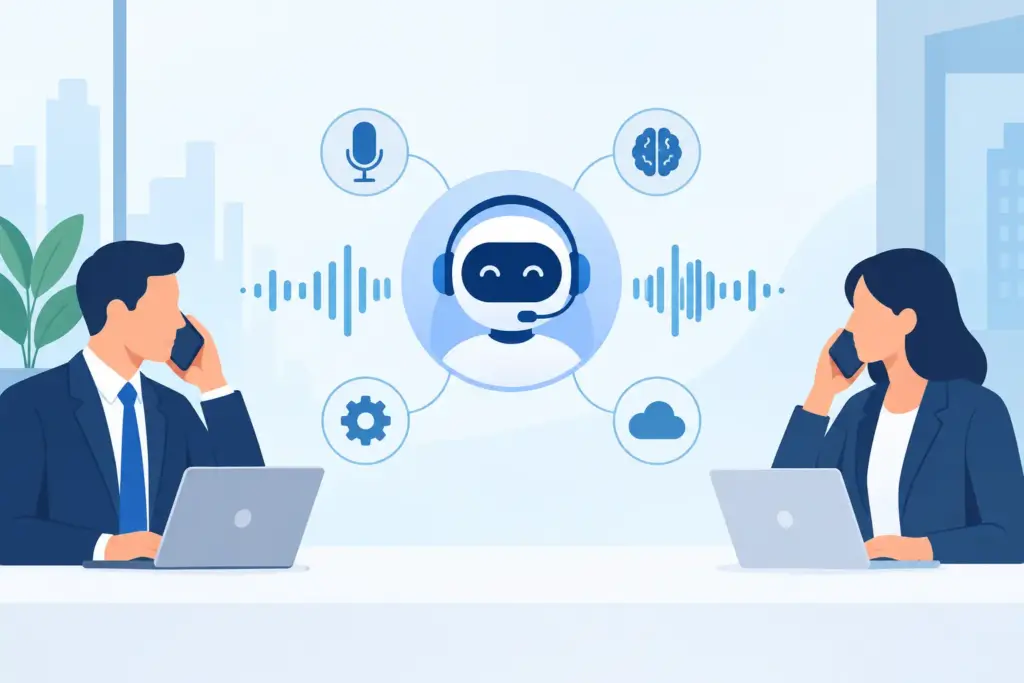
A customer calls at 8:12 p.m. to reschedule a service appointment, check an order status, or report an urgent issue. An AI voice agent can answer on the first ring, understand what the caller means, retrieve the right record, complete the next step, and document the interaction. That is the practical answer to how do AI voice agents work: they combine cloud telephony, speech AI, business-system integrations, and governed automation into a live voice workflow.
For enterprise communications leaders, the value is not a novelty voice bot. It is an always-on operational layer that reduces queue pressure, extends service coverage, and gives human teams more time for cases that require judgment. The quality of that layer depends as much on call routing, latency, data access, and escalation design as it does on the AI model itself.
How Do AI Voice Agents Work From Call to Resolution?
An enterprise AI voice agent operates as a sequence of connected services, each responsible for a different part of the conversation. The caller experiences one natural interaction. Behind the scenes, the platform must receive the call reliably, process speech quickly, interpret intent, use approved data and workflows, and either resolve the request or transfer it with context.
1. Carrier-grade telephony receives and routes the call
The process begins before the agent speaks. An inbound call reaches the organization through SIP trunks, cloud PBX services, contact center routing, or a Microsoft Teams calling environment. The voice platform identifies the dialed number, caller information, time of day, language preference, location, and any routing rules associated with that call path.
This telephony foundation matters. A well-designed deployment can route calls to an AI agent for after-hours coverage, overflow handling, appointment requests, or a specific department, while preserving existing direct-dial and emergency calling policies. Multi-carrier redundancy, monitoring, and failover determine whether the agent remains reachable when a single carrier path or site is unavailable.
2. Speech recognition turns audio into usable text
As the caller speaks, automatic speech recognition converts audio into text in near real time. Modern systems do not wait for a caller to finish a long monologue. They process short audio segments continuously, which allows the agent to respond with the pace expected in a phone conversation.
Speech recognition has to account for accents, industry vocabulary, product names, background noise, and callers who change direction mid-sentence. A healthcare scheduling agent, for example, needs to recognize provider names and appointment types. A field service agent may need to distinguish a model number from a street address. Enterprises get better results when they configure terminology, test real call patterns, and continuously review transcripts for recognition errors.
3. The AI interprets intent and manages the conversation
Once speech becomes text, the conversational AI determines what the caller is trying to accomplish. It uses the current statement, prior turns in the conversation, approved knowledge, and available customer context to decide what to say or do next.
This is more than keyword matching. If a caller says, “My technician never showed up, and I need someone here before tomorrow,” the agent should recognize both the missed-service issue and the urgency. It may verify identity, check the service record, offer the next available appointment, or escalate based on service-level rules.
A language model helps the agent handle natural phrasing and follow-up questions. Guardrails keep that flexibility within operational boundaries. The agent should not invent an order status, promise an unauthorized credit, or disclose account data before verification. In enterprise use cases, controlled workflow execution is often more valuable than open-ended conversation.
4. Integrations let the agent take action
An AI voice agent becomes useful when it can do more than answer general questions. Through APIs and approved connectors, it can read and write information in CRM, scheduling, ticketing, ERP, payment, dispatch, and knowledge-base systems.
Consider a common service scenario. The agent verifies the caller using a phone number and additional authentication step, finds the open work order, checks technician availability, offers two appointment windows, confirms the selection, updates the dispatch platform, and sends an SMS confirmation. The caller receives a completed outcome without waiting for a live representative.
The integration design should be deliberate. Read-only access may be appropriate for order tracking, while appointment changes or payment actions require stronger authentication, confirmation prompts, audit logging, and narrowly scoped permissions. The goal is not to connect every system indiscriminately. It is to automate the workflows that create the most queue volume and repetitive agent effort.
5. Text-to-speech delivers a natural response
The final step is text-to-speech, which converts the agent's approved response back into spoken audio. Voice quality, pronunciation, pacing, and interruption handling influence whether the interaction feels efficient or frustrating.
The strongest implementations allow callers to interrupt. If the agent begins reading a long explanation and the caller says, “Just tell me when it ships,” the system should stop speaking, recognize the new request, and respond directly. Low-latency audio is essential here. A technically correct answer that arrives after an awkward pause still produces a poor customer experience.
The Architecture Behind Reliable Voice AI
Voice AI is often evaluated as a conversational feature, but enterprise performance is an architecture question. The agent needs dependable calling, secure integrations, observability, and a clear path to human support.
A typical environment includes a cloud voice platform, SIP connectivity, an AI orchestration layer, speech services, integration middleware, customer-data systems, and analytics. It may also connect to contact center platforms such as Genesys or 8x8, collaboration systems such as Microsoft Teams, and existing Cisco or legacy PBX environments. The right model depends on whether the organization is consolidating communications or extending an established stack.
Latency deserves particular attention. Each component adds processing time: audio transport, speech recognition, AI reasoning, data retrieval, text-to-speech, and audio delivery. A slow CRM query can make an otherwise polished agent sound unresponsive. Teams should measure end-to-end response times under real call volume, not only in a scripted demonstration.
Reliability also requires fallback behavior. If a downstream scheduling system is unavailable, the agent should acknowledge the limitation, capture a callback request, create a ticket if possible, or route the caller to an appropriate team. It should never pretend a transaction was completed when the system of record did not confirm it.
Where AI Voice Agents Deliver the Most Value
The best use cases share three traits: high call volume, repeatable intent, and a defined action or answer. Appointment scheduling, order and shipment status, account updates, payment reminders, intake, password-reset triage, dispatch requests, and after-hours service are strong candidates.
AI agents are also effective as a front door for complex environments. They can identify the reason for a call, collect essential information, authenticate the caller, and route the interaction to the right queue with a concise summary. This reduces transfers and prevents customers from repeating their issue after reaching a live specialist.
Not every interaction should be fully automated. Escalations involving safety, legal exposure, sensitive medical or financial decisions, highly emotional complaints, and unusual exceptions need human judgment. The operational objective is not to eliminate people from the service model. It is to remove avoidable hold times and reserve skilled staff for work that benefits from expertise.
Governance Turns a Voice Agent Into Enterprise Infrastructure
Because voice agents interact with customers and business systems, governance cannot be an afterthought. Organizations need defined rules for authentication, consent, recording disclosures, data retention, access controls, audit trails, and escalation. Requirements vary by industry, geography, and the type of data handled.
Conversation design should also include confidence thresholds. When speech recognition is uncertain or the AI cannot confidently map a request to an approved workflow, the correct response is clarification or transfer, not a guess. Monitoring should track containment rate, transfer reasons, abandonment, repeat callers, average time to resolution, failed integrations, and customer sentiment.
That data creates a practical improvement cycle. Teams can identify which intents drive the most transfers, refine prompts and knowledge, add missing integrations, and adjust routing. An agent that starts with after-hours scheduling can expand into overflow support or proactive outbound notifications once it demonstrates consistent performance.
UCC Networks approaches this as a communications engineering program rather than a standalone chatbot project. AI voice automation performs best when carrier connectivity, unified communications, contact center workflows, and business-system integrations are designed as one operating environment.
Designing for Zero Hold Times Without Losing Control
A successful deployment starts with a narrow, measurable workflow. Map the call journey, define what the agent is authorized to do, document every integration dependency, and establish the exact conditions that trigger a human handoff. Test with real caller language, regional accents, interrupted speech, incomplete account information, and system failures.
Then measure outcomes that matter to operations: calls answered immediately, requests resolved without transfer, reduced queue time, lower cost per interaction, and faster completion of revenue or service workflows. A high containment rate is useful only if customers receive accurate answers and can reach a person when the situation requires it.
The most valuable question is not whether an AI voice agent can hold a conversation. It is whether it can carry a customer request from the phone network to a verified business outcome, reliably, securely, and without making the caller wait.