Enterprise Voice Disaster Recovery That Works
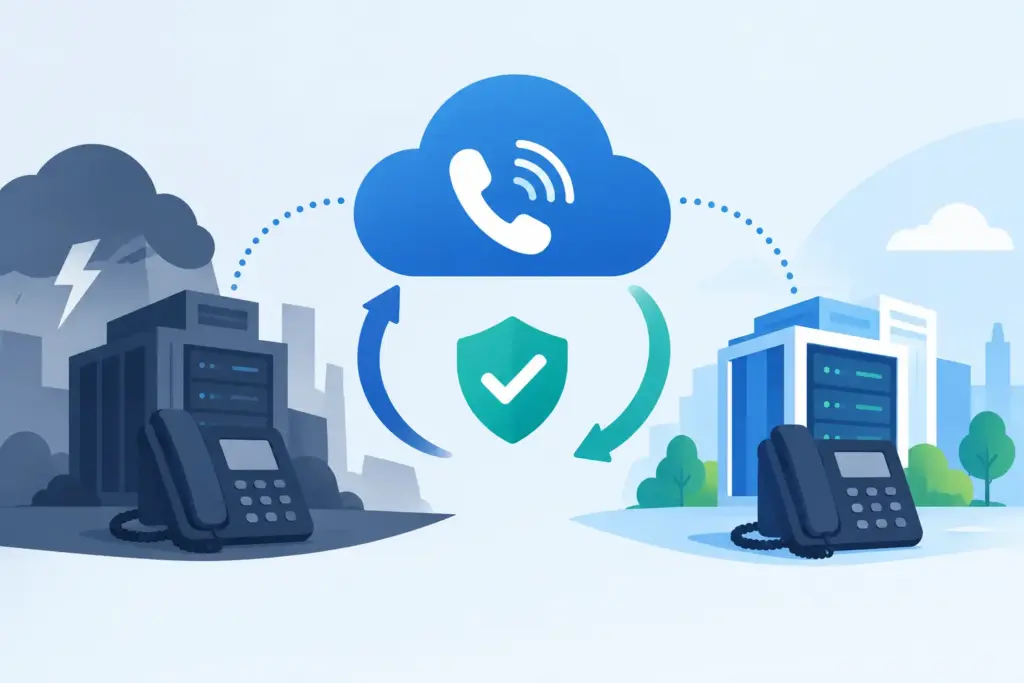
A carrier outage at 9:12 a.m. can look like a contact center failure by 9:15. Customers hear a busy signal, branch employees lose their published numbers, and executives discover that a recovery plan built around email does not help when the phone is the front door to the business. Enterprise voice disaster recovery is the discipline of keeping that front door open when a carrier, site, network, application, or security event fails.
For enterprises, this is not simply a matter of forwarding a main number to a few mobile phones. Recovery must preserve call routing logic, emergency calling, contact center queues, compliance requirements, user identity, and the customer experience. The objective is continuous uptime for essential voice services, with a documented path to restore full capability without improvising during an incident.
Why Enterprise Voice Disaster Recovery Is Different
A traditional PBX recovery plan often assumes the failure is local: move calls to another physical system, activate a backup circuit, or send staff home. Modern communications environments have more dependencies. Voice may traverse a cloud calling platform, SBCs, SIP carriers, SD-WAN, identity services, CRM integrations, contact center applications, Microsoft Teams, and AI voice workflows before a call reaches an employee.
That architecture creates flexibility, but it also expands the failure domain. A redundant internet circuit does not protect against a carrier-side routing problem. A cloud UC platform does not automatically solve an identity outage. A backup data center cannot preserve service if its routing rules have never been tested under actual call volume.
The practical question is not, “Do we have redundancy?” It is, “What happens to an inbound customer call when this specific dependency fails?” Every critical calling path needs an answer.
Start With Call Flows, Not a Vendor Checklist
The strongest recovery designs begin by mapping business-critical call flows. That includes more than the corporate main number. Identify sales lines, patient or member support, dispatch, emergency operations, executive hotlines, after-hours service, branch numbers, toll-free services, and contact center queues. Then document where each call enters, how it is routed, which systems influence the path, and where it can safely terminate during a disruption.
This process frequently exposes a gap between a technical inventory and operational reality. A company may have two SIP trunks but only one configured carrier route for its toll-free number. It may have remote-work capability, but supervisors cannot monitor queues if a contact center integration is unavailable. Or it may have an emergency forwarding plan that sends hundreds of calls to a team with no visibility into wait times or abandoned calls.
Recovery priorities should reflect business impact. A regional office extension can tolerate a different recovery time objective than a 24/7 customer service line. Some organizations need sub-minute rerouting for revenue or safety reasons. Others can accept a short interruption if the fallback preserves accurate messaging and callback capture. The design depends on the use case, but the expected result must be explicit.
Build Redundancy Across the Voice Stack
Enterprise voice disaster recovery is strongest when redundancy exists at multiple layers rather than in one product feature. A resilient design commonly includes diverse carrier connectivity, geographically separate points of presence, alternate routing paths, and independent options for inbound and outbound calling.
Carrier and number-level failover
The carrier layer is where recovery begins for many inbound failures. Multi-carrier architecture reduces exposure to a single provider outage, but redundancy only helps if numbers can be rerouted quickly and the alternate path has enough capacity. Enterprises should validate whether failover is automated, how route changes are authorized, and whether the backup carrier can support toll-free, local, international, and emergency-related requirements.
Number portability and ownership also matter. If critical numbers are tied to a legacy provider through restrictive contracts or incomplete documentation, recovery becomes slower when speed matters most. Maintain a current inventory of numbers, carrier account credentials, routing contacts, service addresses, and escalation procedures in a secure but accessible location.
Network and site resilience
Voice quality is sensitive to latency, jitter, packet loss, and DNS failures. A second circuit at the same building entrance may protect against one access failure but not a construction cut, power event, or local provider issue. Diverse last-mile paths and carrier diversity offer stronger protection, particularly for major sites, contact centers, and operations centers.
Site failure requires another decision: should employees work from home, move to another office, or have calls routed to a cloud-based team? Cloud calling and Microsoft Teams can make user mobility far easier, but endpoint readiness still matters. Headsets, device policies, home-network guidance, and secure access procedures must be available before the incident, not distributed while customers wait.
Application and routing continuity
Auto attendants, hunt groups, queues, and IVR menus are often treated as convenience features. During an outage, they become the customer experience. A fallback routing plan should retain essential menu options, business hours, overflow rules, and on-call schedules. If full CRM screen pops or advanced skills-based routing are unavailable, the organization may need a simplified queue that prioritizes live answer, callback collection, or an accurate status message.
This is also where AI voice automation can provide a meaningful continuity layer. An always-on voice agent can answer routine inquiries, identify intent, schedule service, capture details, and route urgent requests when live teams are constrained. It should not be positioned as a substitute for every recovery workflow. Complex escalations, regulated interactions, and high-emotion calls may require a defined human path. But for high-volume, repeatable requests, AI can reduce queue pressure and eliminate unnecessary hold times during disruption.
Design for Failover Without Losing Control
Automatic failover is valuable only when operations teams can see what happened and intervene when needed. Enterprises need real-time visibility into call attempts, route changes, queue depth, answer rates, and carrier performance. Without it, a recovery event can appear successful at the network layer while customers abandon calls in an overloaded fallback queue.
Define who has authority to activate manual rerouting, change greetings, disable a failed destination, or move priority traffic. Include IT, telecom, contact center leadership, security, and business operations in the operating model. A carrier escalation process owned only by one administrator is a risk if that person is unavailable.
Emergency calling deserves separate attention. A user who shifts from a headquarters desk phone to a remote softphone may have a different location record. Recovery procedures must account for emergency address management, location updates, and notification requirements. This is an area where convenience-based workarounds can create unacceptable exposure.
Test the Plan Under Real Conditions
A disaster recovery document is not evidence of recovery capability. Testing is. The most useful exercises simulate the failures most likely to affect your environment: a primary carrier outage, an internet circuit failure, a site power loss, an identity-service interruption, a contact center platform degradation, or a cyber event that requires isolating systems.
Test during realistic traffic periods when possible. Verify not only that calls complete, but that they arrive at the right destination, preserve caller ID where expected, receive the correct announcement, and appear in reporting. Measure reroute time, audio quality, queue capacity, agent readiness, and the time required to restore normal routing.
After each exercise, update the runbook. Remove assumptions that did not hold. Record the actual contacts, commands, approvals, and dependencies required. Recovery plans age quickly when numbers are ported, offices close, teams reorganize, or a new collaboration platform is introduced.
Align Recovery With Your Communications Modernization Plan
Organizations with fragmented PBXs, multiple carriers, and disconnected collaboration tools often find that disaster recovery exposes the cost of complexity. Consolidating voice architecture does not mean forcing every location into one identical configuration. It means establishing centralized visibility, repeatable routing standards, and consistent controls while supporting the realities of different sites and business units.
For example, a company using Microsoft Teams for internal collaboration may need carrier-grade Teams calling for employees, a dedicated contact center path for customer-facing teams, and independent SIP failover for critical analog or legacy systems. These environments can coexist if the architecture is intentional. The trade-off is that each integration must have a defined recovery behavior, rather than being assumed to inherit the resilience of the broader platform.
UCC Networks approaches this work as communications engineering, combining multi-carrier infrastructure, cloud voice architecture, Teams integration, and operational voice automation around the call flows that keep the business running. The right design is not the one with the most redundancy on a diagram. It is the one that keeps priority callers connected, gives operations teams control, and recovers predictably when a dependency fails.
A useful next step is to choose one critical phone number and trace it from carrier ingress to final answer. If the team cannot explain its alternate path, owner, capacity limit, and test date in a few minutes, that number is an excellent place to begin strengthening recovery.