Enterprise Telephony Architecture Guide for IT
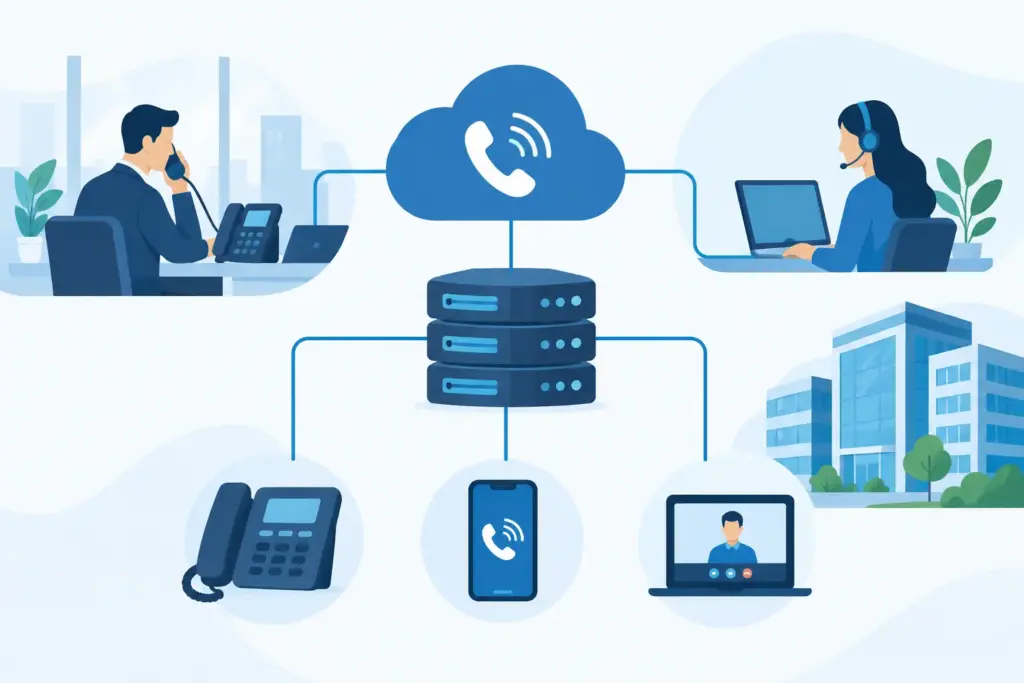
A phone system failure rarely stays contained to the phone system. It delays customer service, interrupts sales, strands remote employees, and forces IT into manual workarounds. This enterprise telephony architecture guide outlines how to design voice infrastructure as a continuously available business service, not a collection of trunks, handsets, and routing rules.
For enterprise IT leaders, the objective is not simply to replace a PBX with cloud calling. The objective is to create a controlled communications layer that supports employees, contact centers, collaboration platforms, and automated customer interactions without introducing new points of failure.
Start With the Operating Model, Not the Platform
Architecture decisions should begin with how the organization receives, routes, and resolves communications. A distributed healthcare provider, multi-site manufacturer, financial services firm, and national retail organization may all require cloud voice, but their call flows, compliance obligations, survivability requirements, and escalation paths will be different.
Map the operational moments where voice matters most: inbound customer calls, emergency calling, branch survivability, executive communications, contact center overflow, after-hours service, and employee collaboration. Then identify who owns each workflow. If customer experience owns queue strategy while IT owns carrier services and facilities owns emergency location data, the architecture must make those responsibilities visible rather than burying them in a vendor portal.
This approach exposes fragmentation early. Many enterprises still operate a mixture of legacy PBXs, separate SIP carriers, Microsoft Teams calling, contact center platforms, mobile devices, and standalone AI tools. The problem is not that every component is inherently wrong. The problem is that disconnected components create inconsistent routing, duplicate administration, unclear incident ownership, and unpredictable costs.
Build the Enterprise Telephony Architecture in Layers
A resilient design separates functions into layers so the failure or replacement of one component does not force a full communications redesign. The core layers are carrier connectivity, call control, collaboration, contact center operations, automation, network services, and management.
Carrier connectivity and PSTN access
Carrier-grade connectivity is the foundation. Enterprises should evaluate more than price per channel or port. Ask how calls enter the network, where redundancy exists, how inbound numbers fail over, what happens during a regional outage, and how quickly routes can be changed during an incident.
Multi-carrier redundancy can reduce exposure to a single upstream provider, but it must be paired with tested routing logic. A backup carrier that has never been exercised is not a continuity plan. Design for number portability, diverse ingress paths where required, failover policies, and real-time visibility into call completion and quality.
For global organizations, regional regulation and local numbering requirements introduce another layer of complexity. Centralized administration is valuable, but it should not ignore country-specific emergency calling, caller ID, recording, and data-handling rules.
Call control and session management
The call control layer determines how users, devices, queues, and applications interact with the public telephone network. In a modern environment, it may include cloud PBX services, SIP session management, SBCs, dial plans, and direct-routing services for Microsoft Teams.
This layer should standardize identity and dialing behavior across locations. Employees should not need to understand whether a colleague uses Teams, a desk phone, a softphone, or a legacy extension. The experience should be consistent, while the underlying architecture retains the flexibility to support specialized devices and existing investments where needed.
Session border controllers remain critical in many environments. They help enforce security policy, normalize signaling between platforms, and control how traffic enters and exits the enterprise. The right deployment model depends on scale, compliance, connectivity, and application mix. A cloud-first organization may centralize these capabilities, while a site with local survivability requirements may need an edge component.
Collaboration and user communications
For organizations standardized on Microsoft 365, carrier calling inside Microsoft Teams can reduce tool switching and simplify the employee experience. Teams Connect architecture should address direct routing, number assignment, emergency location management, quality monitoring, and support boundaries between Microsoft, the carrier, and the managed service provider.
The trade-off is that Teams is not automatically the right endpoint for every role. Reception consoles, analog devices, overhead paging, trading floors, common-area phones, and specialized contact center users may need different treatment. A sound design integrates those requirements rather than forcing every workflow into a single interface.
Contact center and AI automation
Contact center architecture should be connected to enterprise telephony, not treated as an isolated island. Customer calls need intelligent routing between IVR, AI voice agents, live agents, subject-matter experts, and back-office teams. The architecture must preserve context when a call moves from automation to a person, or the organization simply replaces hold time with repetition.
Conversational voice AI is particularly effective for high-volume, repeatable requests such as appointment scheduling, order status, intake, payment reminders, location information, and service dispatch. A well-designed AI agent can answer immediately, understand natural speech, authenticate or collect relevant details, execute approved workflows, and escalate exceptions with a concise interaction record.
Not every call should be automated. Sensitive complaints, complex technical cases, regulated transactions, and emotionally charged situations need carefully designed human escalation. The goal is zero hold times for routine demand and faster access to qualified people when human judgment is required.
Engineer for Failure, Not Just Normal Traffic
Continuous uptime is an architecture discipline. It comes from anticipating failed carriers, unreachable sites, degraded internet circuits, unavailable applications, power events, and configuration errors.
Document call treatment for each failure scenario. If a branch loses connectivity, can calls reroute to a mobile device, another location, or a centralized queue? If the contact center platform is unavailable, can essential calls land with trained backup teams? If a primary SIP route fails, does traffic move to an alternate carrier automatically, and are the resulting caller ID and recording requirements still met?
Network readiness matters as much as telephony design. Voice traffic needs predictable latency, low jitter, controlled packet loss, QoS policies, and capacity planning that accounts for busy-hour usage. Wi-Fi and internet circuits should be tested against real calling patterns, not only basic speed-test results. Voice quality monitoring should identify whether a problem originated with the endpoint, local network, WAN, provider, or application.
Security also belongs in the operational design. Apply identity controls, least-privilege administration, fraud detection, call recording policy, encryption where appropriate, and disciplined change management. Toll fraud and unauthorized configuration changes can create material financial and operational exposure in a short period.
Treat Migration as a Controlled Service Transition
The highest-risk phase of a telephony modernization program is usually migration. Number porting, dial-plan translation, endpoint provisioning, emergency calling, contact center routing, and user adoption all converge at once. A zero-downtime migration is possible only when the plan accounts for dependencies in detail and includes rollback paths.
Start with an inventory that captures numbers, carriers, circuits, call flows, hunt groups, auto attendants, analog devices, integrations, and business owners. Then segment the migration into logical waves. A low-risk administrative group can validate provisioning and support processes before a large customer-facing location moves.
Parallel operation is often worth the added effort. It provides a controlled period to test inbound and outbound calling, emergency services, voicemail, recording, integrations, and failover behavior before legacy services are retired. The correct balance depends on carrier contract dates, technical complexity, and risk tolerance, but an accelerated cutover should never mean an untested cutover.
User communications are part of the architecture outcome. Employees need clear instructions, but service desk teams also need escalation paths, troubleshooting tools, and access to engineers who understand the design. Commodity support models often fail here because they treat a business-critical routing issue as a standard ticket.
Establish Ongoing Governance and Measurable Performance
Enterprise telephony is not finished at go-live. It needs governance across capacity, costs, security, user lifecycle management, routing changes, and application integrations. Centralized administration can eliminate duplicate work, but it should include approval controls so local teams can request necessary changes without creating unmanaged complexity.
Track metrics that reflect real service quality: call completion, answer speed, abandonment, transfer rate, voice quality, queue containment, AI resolution rate, carrier failover events, and time to restore service. The useful metrics differ by department. A contact center director may prioritize abandonment and resolution, while an infrastructure leader may focus on availability, incident response, and carrier performance.
Architecture reviews should also revisit the business case. If Teams calling reduced separate voice tools, are licenses and carrier services actually being consolidated? If AI automation was deployed to absorb routine volume, are wait times and after-hours coverage improving? Measurement keeps modernization tied to operational outcomes rather than feature adoption.
A well-engineered communications environment gives the enterprise a dependable path from every incoming call to the right resolution. Organizations planning major consolidation, Teams integration, contact center modernization, or AI voice deployment should engage a communications specialist early, while there is still room to design resilience into the foundation.